
Chapter Eleven
Tapping
Here is an asymmetry in this trade that almost nobody names. A technician will spend years and a great deal of money on tools that work from behind the panel. Hundreds of them. Lengths, bends, tips, handles, whale tails, hooks, wedges. Then he turns the same problem around, reaches for the painted side, and works with two knockdowns and whatever he happens to hit them with. Even experienced technicians are extremely limited on the surface, and it costs them far more than they realise. Just because you have been getting away with something for a long time does not mean it is the right way.
Hundreds of tools for behind the panel. Two knockdowns for the front. That is not a preference. It is a gap.
11.1The strike pair
Start with something structural that the trade talks about loosely. When you tap, you are not using one tool. You are using two, and they multiply. There is the knockdown or tap down itself, whatever it is made of, and there is the object that strikes it, whatever that is made of. The event the panel receives is the product of both. A hard tip struck by a hard hammer is not the same event as the same tip struck by a soft one, and neither is the same as a soft tip struck hard.
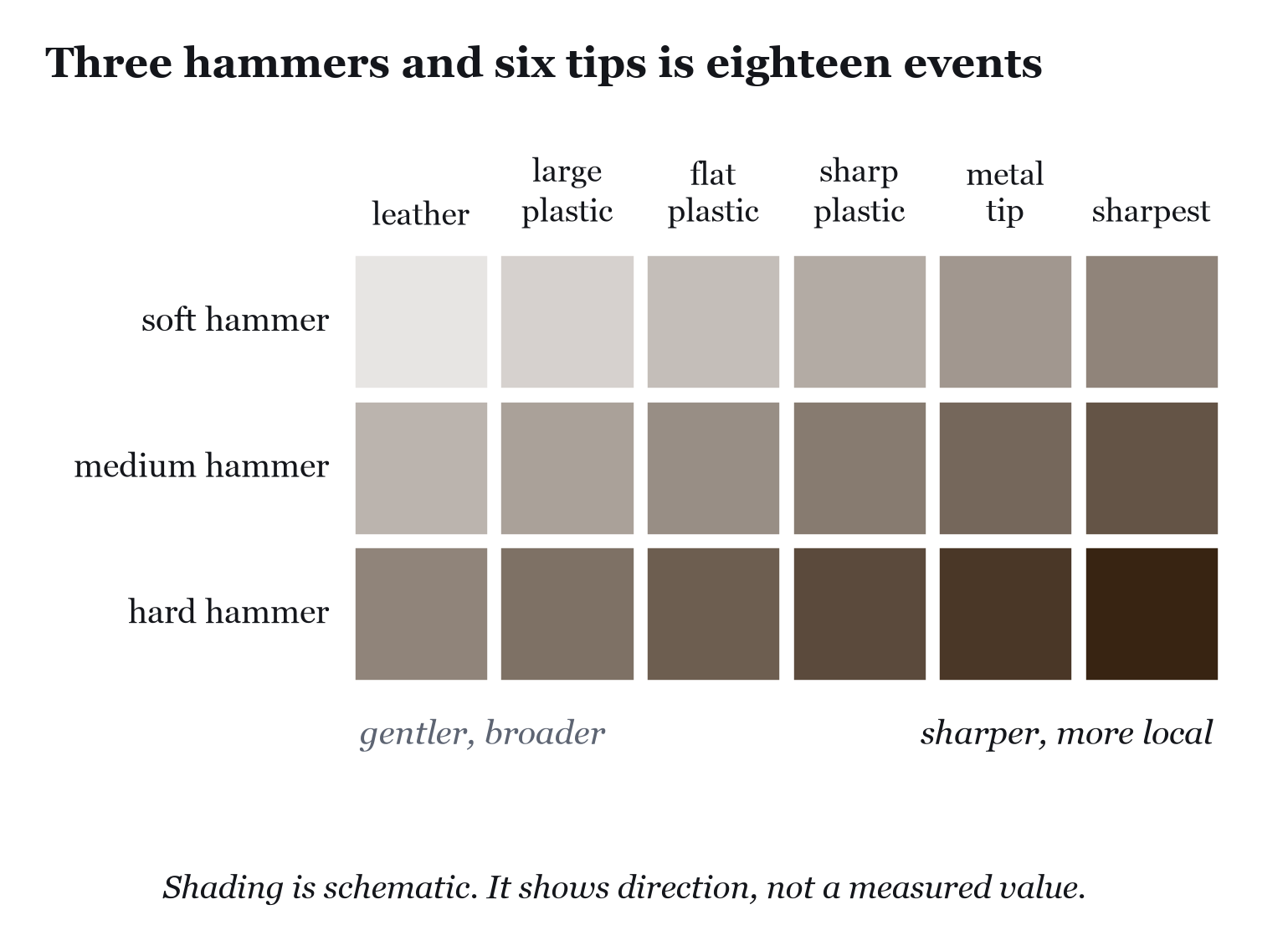
I want to give that pair a name, because a thing without a name cannot be reasoned about, and this book has already spent a chapter on that argument. Call it the strike pair: the tip and the hammer, considered together, because the panel cannot tell them apart. Once you think in pairs, the arithmetic changes. Three hammers and six tips is not nine tools. It is eighteen different events, and a technician carrying one hammer has thrown away two thirds of his range before he starts.
11.2The kit that actually leaves the van
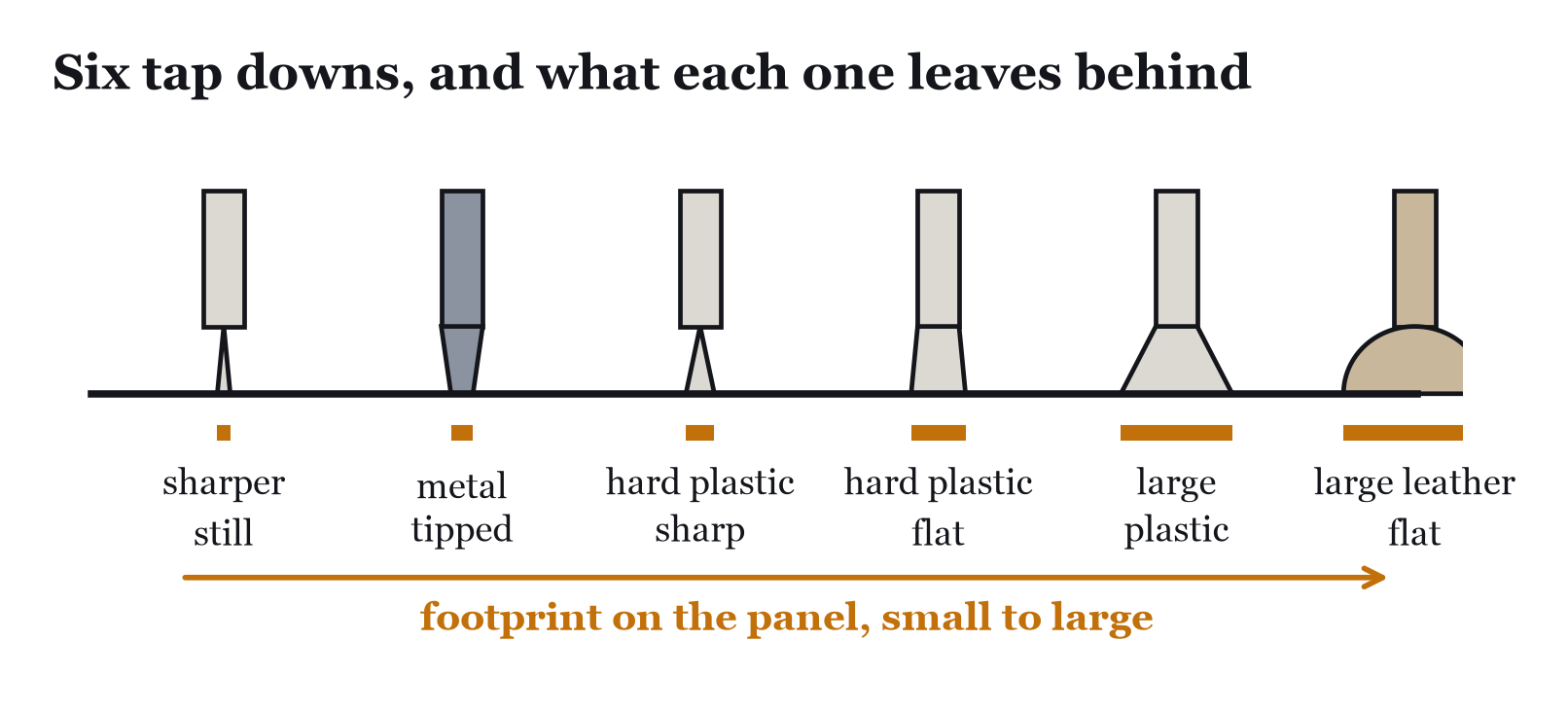
So here is what I carry, and why. At a minimum, three hammers, so that the striking half of the pair is a choice rather than a constant. Then the tips. This is not a shopping list for its own sake: each one exists because there is a job the others do badly.
- A hard plastic, sharpthe precise one
- For a small, tight high that has to come down without touching what is around it.
- A hard plastic, flatthe ordinary one
- The general worker. Most taps on most panels.
- A large leather, flatthe forgiving one
- Broad and soft. Where the finish is fragile or the high is wide and shallow.
- A large plasticthe mover
- Sized to bring a lot of metal down in one action rather than in twenty.
- A metal-tipped knockdownthe authority
- A dense tip in a plastic body, for highs that a plastic face will not answer. The Carepoint 212 is the type: a fluoroplastic knockdown with a titanium tip.1 The VIP knockdowns cover the same ground.2
- Sharper stillthe last resort
- Beyond the metal-tipped knockdown there is a sharper class again, for the work Paul calls crushing. Use it knowing exactly what it does, which is to concentrate everything you give it into almost no area at all.
And carry them. I keep a small basket on my hip on every repair. If I do not have my basket, I do not fix dents. That is not a preference either. It is a showstopper, in exactly the way that arriving without a light is a showstopper. I cannot do the work without those tools, so the work does not start until they are on me.
11.3Seated and floating
There are two ways to use a tap down, they produce different results, and the trade has never named either. I am going to, and if better names come along I will take them.
- The seated taptip resting on the panel
- You put the tip down on the spot you mean to move, and then you strike it. The tip is already in contact, so what the panel receives is a controlled impulse passed through a body that is not moving when the hammer arrives. Broader, gentler, more predictable. Most of your taps should be seated taps.
- The floating taptip held a hair above
- You hold the tip ever so slightly off the surface and strike. Now the hammer accelerates the tip across that gap before it lands, so the tip arrives carrying speed of its own. The event is sharper, more local, and less forgiving. It is the right answer sometimes and the wrong one often, and the difference between the two is a fraction of an inch that nobody will ever see you make.
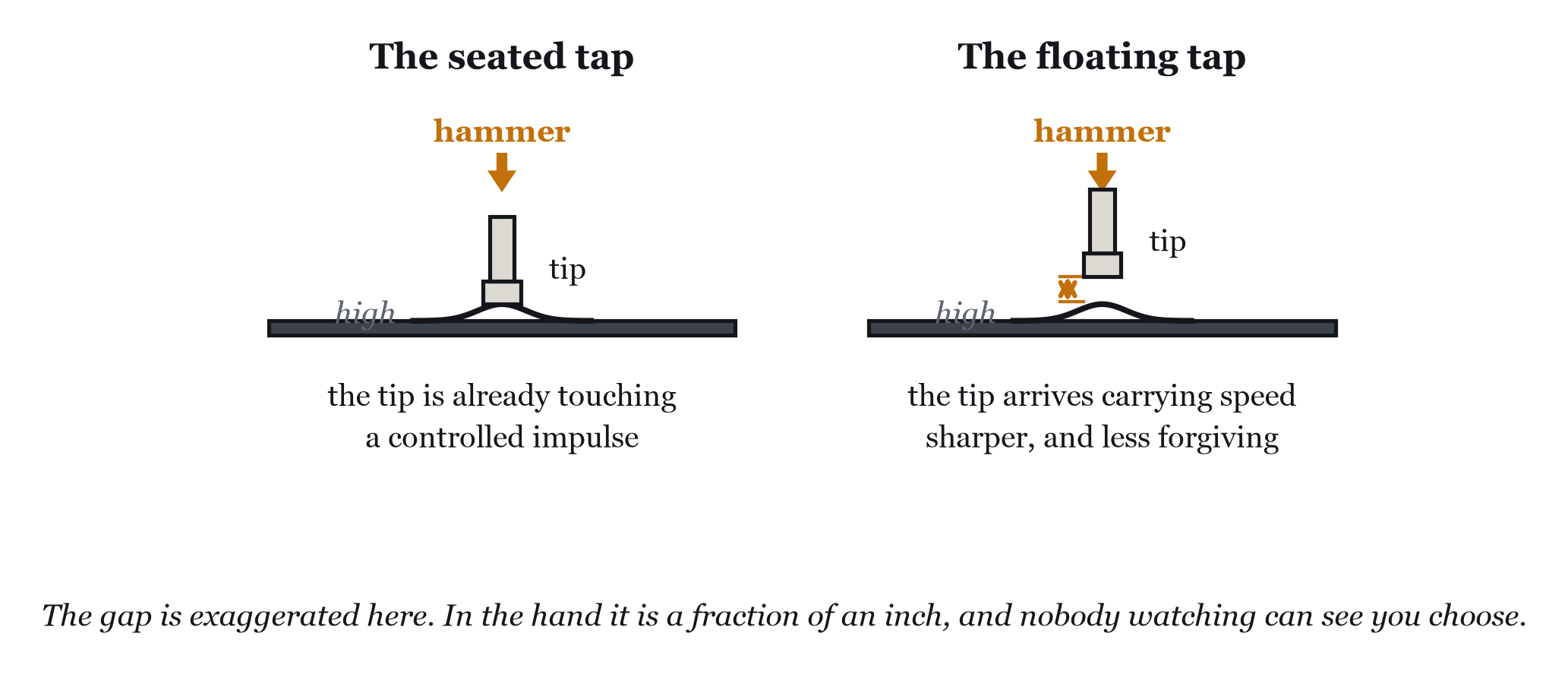
Learn to feel which one you just did. A technician who does not know whether his tip was seated or floating cannot explain why one tap marked the finish and the next did not.
11.4Upkeep is not housekeeping
The condition of a tap down is as important as the choice of it. Surfaces clean. Faces polished. I check the whole basket weekly, and I check it properly rather than glancing at it. A tip that has picked up grit is no longer the tool you think you are holding: it is that tool plus a hard particle, applied to paint, by you.
The rule at the panel is stricter still. If a single strike does not look right, the tool comes off the panel immediately. Not at the end of the row. Not once the pattern is finished. The moment you feel something is off, you stop, you find out what it was, and you correct it while the correction is still small.
A tip that has picked up grit is no longer the tool you think you are holding.
11.5The footprint
Now the principle underneath all of it, and it is the most important idea in this chapter. When you have a large high, you want the largest tool that suits it, so that it comes down in as few strikes as possible and leaves as few dimples behind as it can. The same holds from the other direction: when I push, I want to raise as much metal as smoothly as I can, because that is what makes the fewest taps necessary afterwards.
Read what that actually says, because it is not the same claim chapter fourteen makes about minimum manipulation. Those contacts count your actions. This counts your area. It is not only about quality. It is about leaving undisturbed the metal that was never part of the repair. There is a damaged region on that panel. Ideally it is the only region on the panel that has been touched at all, by anything, from either side. Every dimple outside it is a mark you put on a car that arrived without it.
Call that the repair footprint: the total area you disturbed, as against the area that was damaged. A young technician measures his work by whether the dent is gone. An older one measures it by how little of the panel had to be involved in its going.
The dent is the area that was damaged. The footprint is the area you touched. The trade only counts the first one.
Notes
- The Carepoint 212 is listed by its maker as a “PDR Fluoroplastic knockdown with titan tip,” 120 mm. Carepoint, car-carepoint.com, product 212. Paul described this class of tool as aluminium in the recording this chapter is drawn from; the manufacturer specifies titanium, and the manufacturer is followed here. ↩
- VIP PDR Tools list the 1.5 and 2.0 knockdowns in the same category. vippdrtools.com. ↩