
Chapter One
The Metals
Let us begin with the metals we actually use. Not the ones in a chemistry book: the ones under your hand this afternoon. Every repair involves two pieces of metal, and most technicians can name neither. There is the metal in the panel. It is not what it was twenty years ago, and it is not the same from one car to the next. There is the metal in your hand, which you chose, or more likely inherited from whoever trained you, without ever being told what the choice had cost. This chapter names both. Each gets its proper name, its working number, and its consequence for you.
Every repair involves two pieces of metal, and most technicians can name neither.
1.1The metal in the panel
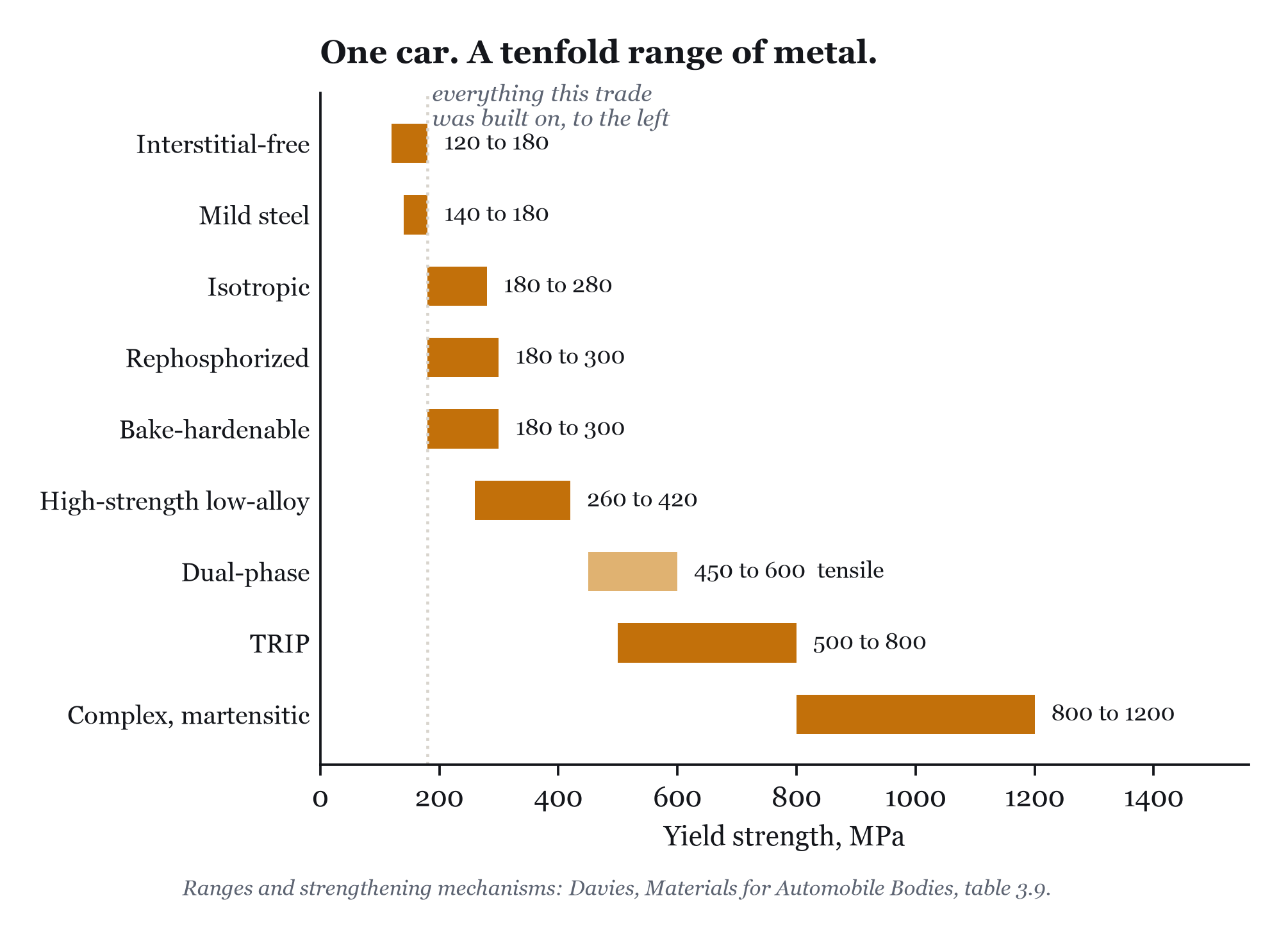
For most of this trade's history you could assume the panel. It was mild steel, it was soft, and it was thick. That assumption is dead. Walk the length of a modern car and you walk a catalogue. One vehicle: half a dozen materials. No badge on the fender to tell you which is which. Here is that catalogue, by name. The figure beside each name is its yield strength: the stress at which the metal stops springing back and begins to stay where you put it. That is the number your rod argues with. The families below, their ranges and their strengthening mechanisms are the standard automotive classification.1
1.1.1The steels
- Interstitial-free steel (IF)down to 120 MPa
- The most willing metal on the car. The carbon and nitrogen are stripped out by vacuum degassing, then mopped up by additions of titanium or niobium: carbon falls from around three hundredths of one per cent to below two ten-thousandths.2 Nothing else on the car draws as deeply, which is why it goes where the forming is most severe. It can yield below the accepted design minimum of 140 MPa.3 Under a rod it moves early and it moves willingly.
Where you have met itDeep-drawn inner structures and the most severely formed outer shapes: inner door panels, wheel housings, floor pans, the deep corners of a quarter panel. You have met it without knowing, and you noticed only that the metal came up easily.
- Mild steel (low-carbon sheet)140 to 180 MPa
- Strengthened by nothing in particular: the residual carbon, manganese and silicon left over from making it.1 This is the metal this trade was built on. Every habit you inherited was formed on it. Most of those habits are older than the car you are standing in front of.
Where you have met itAnything built before roughly the mid 1990s, and the cheap end of the market for a long while after. An older pickup bed, a 1990s sedan door, a work van flank.
- Rephosphorized steel180 to 300 MPa
- Strengthened by solid solution hardening: phosphorus dissolved into the iron itself, stiffening the lattice against slip.1
Where you have met itOuter panels on economy cars of the 1990s and 2000s, where a little strength was wanted without paying for a better grade.
- Isotropic steel180 to 280 MPa
- Strengthened by silicon additions, and named for the property that matters: it behaves the same in every direction of the sheet.1 A rolled sheet normally does not.
Where you have met itOuter skins where the manufacturer cared that the panel behaved the same whichever way the sheet was rolled: doors and hoods on mid-market European cars.
- Bake-hardenable steel180 to 300 MPa
- Strengthened by strain age hardening.1 It arrives at the press soft, forms easily, and then gains its strength in the paint oven. It is specified for outer panels precisely because it gives a balance of formability and dent resistance.4 The skin you work on was designed to resist you.
Where you have met itThe commonest outer skin on the road. Doors, hoods, roofs and fenders across almost every mainstream steel-bodied car of the last twenty-five years. If you are working a hail roof today, this is very probably what is under your tip.
- High-strength low-alloy (HSLA)260 to 420 MPa
- Strengthened by grain refinement and precipitation hardening: tiny alloy particles that pin the grain boundaries.1 Used where a part must be strong without being heavy.
Where you have met itPickup beds and box sides, rocker panels, reinforcements and rails. A modern truck bed floor is a good place to feel the difference against an older one.
- Dual-phase (DP)450 to 600 MPa, tensile
- Islands of hard martensite suspended in a soft ferrite matrix.1 It yields early and then hardens fast. Read the note on its name below, because the number in it is not the number you think.
Where you have met itIncreasingly the outer skin as well as the structure on newer vehicles, and the reason a late-model door can feel wrong to a technician trained on older cars.
- TRIP steel500 to 800 MPa
- Transformation induced plasticity: retained austenite turns to martensite as you deform it.1 It gets harder because you worked it. Every pass you make is an argument with a metal that is learning from you.
Where you have met itEnergy-absorbing members: front rails, sills, pillar reinforcements. It is the thing behind the panel that will not give.
- Complex and martensitic steels800 to 1200 MPa
- Bainitic and martensitic phases created by controlled heat treatment.1 These are the B pillars, the roof rails, the door intrusion beams. This is where our trade ends. Not because you lack skill: because the metal was heat treated to refuse you.
Where you have met itB pillars, roof rails, door intrusion beams, bumper reinforcement bars. Nearly every car built since the mid 2000s has a press-hardened boron ring around the occupant cell. If your rod is on one of these you are on the wrong part.
1.1.2A warning about names
This one has taken money out of technicians' pockets. Japanese practice quotes a steel by its ultimate tensile strength. European practice quotes it by its yield. The grades are named after the Japanese convention, so the number in the name is the tensile figure. DP600 does not have a yield strength of 600. Its European yield figure for the same material is about 340 megapascals.5 One steel. Two numbers, nearly double apart. Both correct. Only one of them is the number your rod argues with. When a body shop tells you a panel is six hundred megapascal steel, they have told you how hard it is to tear, not how hard it is to move.
1.1.3Aluminium, magnesium, and what will not answer
- Aluminium, 5xxx series (Al-Mg)not heat-treatable
- Aluminium with magnesium. Long favoured for panels on cost and formability: about three times the price of zinc-coated steel. It is prone to stretcher-strain marks, the Lüders bands, which appear as the metal yields and can show through the paint.6 Modern designs tend to put it on inner panels.
Where you have met itInner panels and closures on aluminium-bodied vehicles, and utility bodies.
- Aluminium, 6xxx series (Al-Mg-Si)heat-treatable
- Aluminium with magnesium and silicon. Higher yield strength than the 5xxx alloys, and it bake hardens at temperatures approaching 200 °C: the paint oven strengthens it, exactly as it does the steel skins.6 Around five times the price of zinc-coated steel, and worth it to the manufacturer for surface quality. 6016 is the commonest outer skin of the two.
Where you have met itFord F-150 from 2015 on: hood, doors, bed and cab skins over a steel frame. Also the Audi A8, Jaguar XE and XF, Range Rover, Tesla Model S and X, and the hood alone on a long list of otherwise steel cars.
- Magnesium1.74 g/cc
- The lightest engineering metal in the car: thirty-five per cent lighter than aluminium and over four times lighter than steel.7 It arrives as castings, not as a skin you can work.
Where you have met itInner structures you will never put a rod on: steering column brackets, seat frames, instrument panel beams, some inner liftgate structures.
- Polymers and compositesno rod will answer
- Thermoplastics, thermosets, carbon fibre. Named here so that you can recognise them and stop. They do not yield, creep back and hold a new shape the way a metal does. They are not a repair you own.
Where you have met itSaturn body panels of the 1990s, Corvette skins, BMW i3 passenger cell, most modern bumper covers and many fender liners. A magnet on the panel settles this in one second, and that second is the cheapest diagnostic in the trade.
Twelve families, then, and one vehicle may carry six of them. Notice what the ranges do. From the softest interstitial-free steel to a martensitic door beam is a factor of ten in yield strength. That entire range has been rolled thinner than it used to be, because the demand for fuel economy pushed manufacturers toward higher-strength, thinner-gauge material to take weight out of the car.8 Stronger and thinner, at once, on purpose. Both of those moves work against you, and we are about to see exactly why.
Now I want you to notice something. It is the fact that reorganises everything else in this book, and I have never once heard it said on a shop floor. When steel is made stronger, it does not become stiffer. We use the two words as though they were one word. They are not. Strength is the stress at which metal stops springing back and begins to stay where you put it. Stiffness is something else: the resistance to being moved at all, elastically, before any of that permanent business begins. Across the whole automotive range, from the softest grade to the hardest, the stiffness of steel does not move. It sits at roughly two hundred and ten gigapascals for the soft one and the hard one alike.9
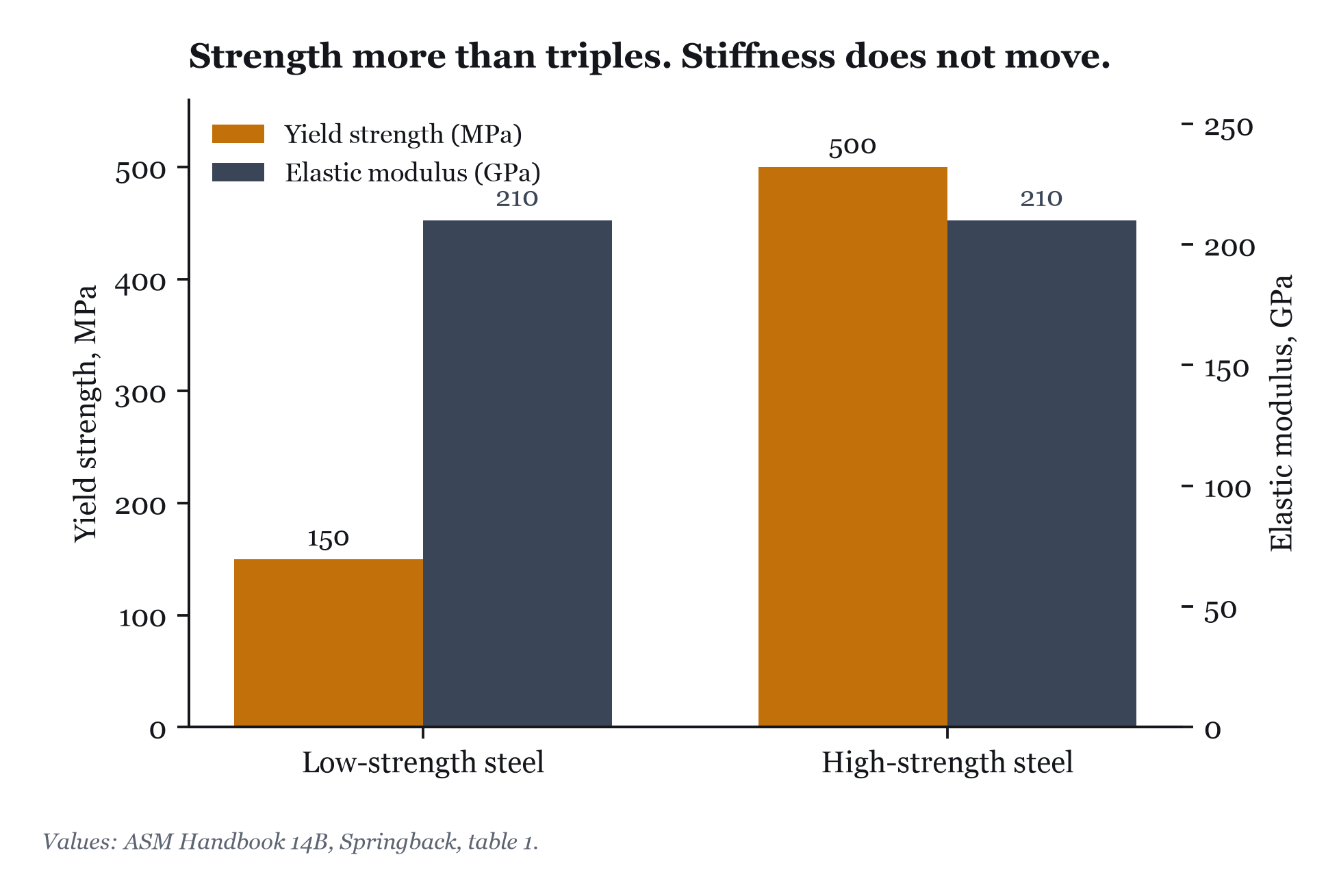
Recall what actually governs the fight you feel at the panel. Springback is the return: the thing that quietly undoes your push while you are still admiring it. It is proportional to strength divided by stiffness, and it rises as the sheet grows thinner.10 Set those facts side by side. The conclusion is not subtle. A manufacturer who triples the strength of a panel, leaves the stiffness where it was, and shaves the gauge for good measure has multiplied the springback several times over and told nobody. The high-strength panel is not harder to move because it is stiffer. It is harder to finish because it keeps coming back. It comes back far more insistently than the mild steel your hands learned on. Aluminium compounds the injury from the other direction. Its modulus is about a third of steel's, so at comparable strength it springs back roughly three times again.11 Stack the two and you may be working a panel that returns several times harder than the one you trained on, with nothing on the outside to warn you.
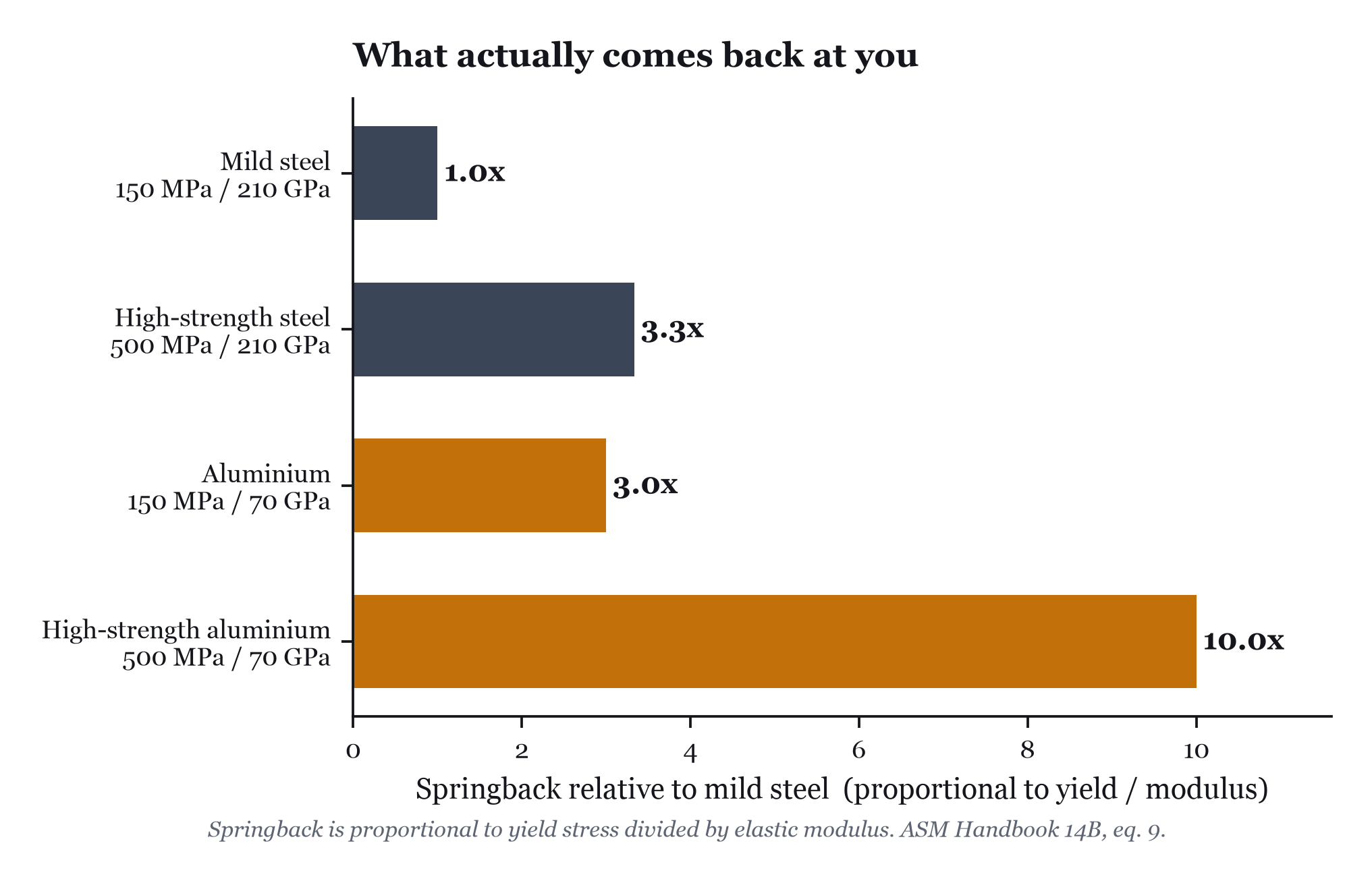
The high-strength panel is not harder to move because it is stiffer. It is harder to finish because it keeps coming back.
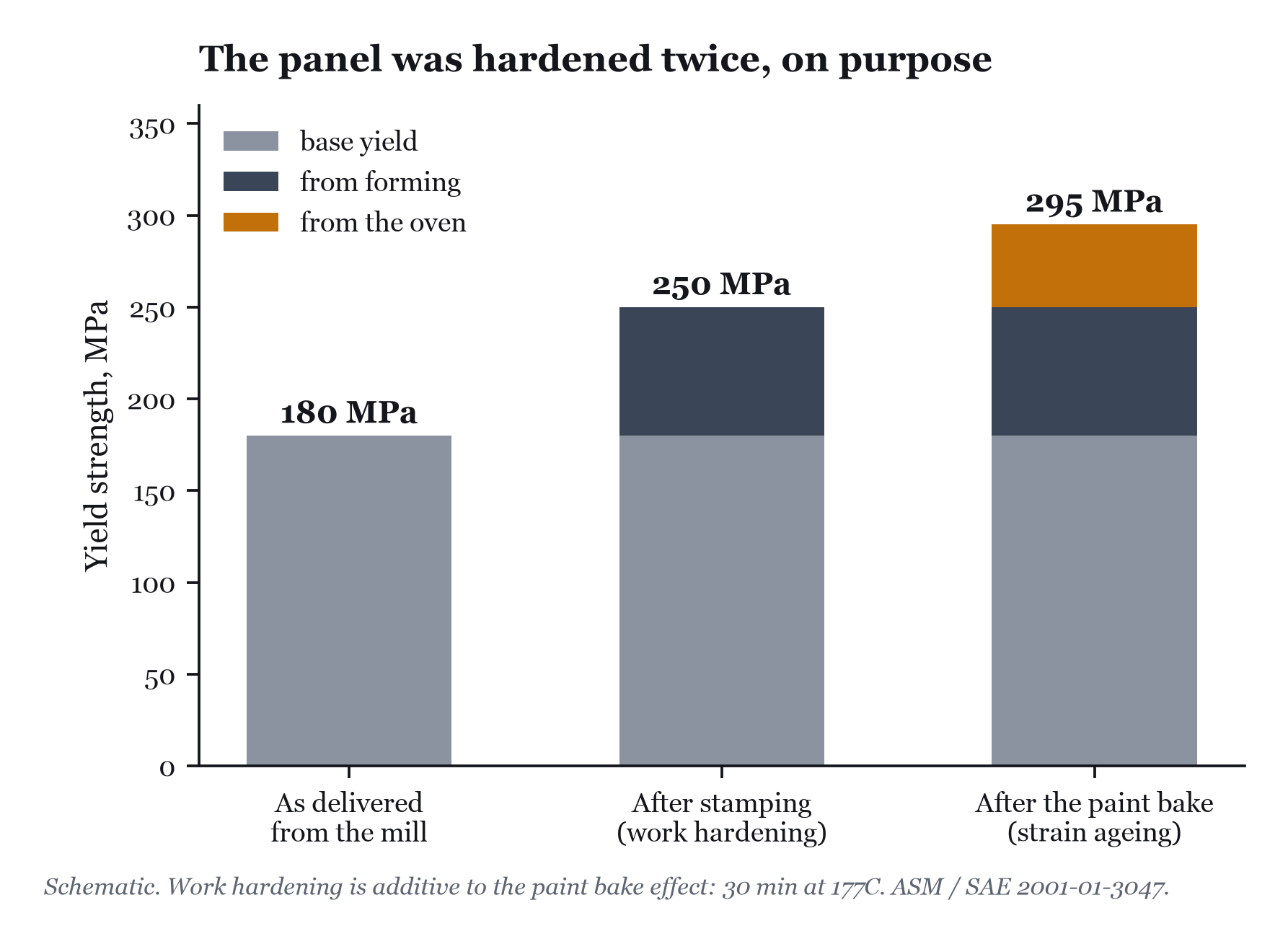
There is one further thing that was done to that panel before ever it met a trolley in a car park. It was done deliberately, by people who were paid to do it. The panel went into an oven: thirty minutes at a hundred and seventy-seven degrees Celsius, three hundred and fifty on the Fahrenheit scale. In that half hour the carbon and nitrogen held in solution within the iron began to move, migrating through the metal toward the dislocations that the stamping had torn open, gathering about them, settling there, pinning them where they lay so that they might never easily move again.12 This is bake hardening. The handbook states the consequence in one flat sentence, and it is worth reading twice: bake hardening makes a formed steel panel stronger after baking than after forming.12 So the panel was hardened once by being stamped, and hardened again by being painted. The second hardening was specified on purpose, because the object of the exercise was a panel that resists denting.4 There are steels sold under names that say so outright. The property that defeats the trolley in the car park is the property that meets your tip, and somebody chose it, costed it, and bought it by the tonne.
1.2The metal in your hand
Now turn the question around. We have a rich vocabulary for damage: crown, crease, embankment, origin, the low. We have almost none for the things we push it with. I searched thirty-three thousand words of my own recorded training for the name of a single tool alloy and found not one. Not titanium. Not spring steel. Not brass. We say a rod, and we say a tip, and there the language stops. A trade that cannot name its own instruments cannot reason about them. So here they are. The figure beside each is its modulus of elasticity: stiffness, not strength. It is the number that decides how much of your hand arrives at the tip, and how much of the panel comes back up the shaft to tell you what happened.13
1.2.1The tool metals
- Spring steel and high-carbon steelE ≈ 200 GPa
- The ordinary rod, and the reason the ordinary rod feels the way it does. High stiffness means the push you make is the push that arrives. It also means the tool takes a set if you exceed it, and a rod with a memory of its own is a rod that lies to you.
Whose toolsDentcraft builds its rod line from high-carbon, hard-tempered spring steel with an anti-rust coating, and argues publicly that it outperforms stainless on strength. The Tequila fixed-handle picks sold through Anson are described as precision spring steel.
- Stainless steelE ≈ 193 GPa
- Within a few per cent of carbon steel in stiffness. You are buying corrosion resistance and surface, not a different feel. Anyone who tells you a stainless rod is softer in the hand is describing its heat treatment, not its metal.
Whose toolsA-1 Tool runs a full parallel stainless line, from 5/16 inch up to 5/8 inch, alongside its standard rods. Finesse builds in stainless throughout, and its 222 flat bar is hardened stainless at one and a half inches wide by three sixteenths thick. Ultra Dent Tools works in high-carbon stainless, machined and hardened. Anson carries the stainless Tequila whale tails and picks.
- Alloy steel, chrome-moly familyE ≈ 205 GPa
- Also within a few per cent. Here is the thing worth learning: you cannot buy stiffness with an alloy of steel. Every steel on earth has about the same modulus. Heat treatment changes what it takes to bend it permanently. It does not change how far it flexes on the way there.
Whose toolsHeavier bars, braces and slide-hammer shafts rather than working rods.
- TitaniumE ≈ 105 GPa
- About half the stiffness of steel, and about fifty-six per cent of its density.14 The lightness is the reason people buy it. The flex is what they actually get. A titanium rod of identical length and diameter bends roughly twice as far under the same hand.
Whose toolsBlending hammer heads above all: Dentcraft sells a titanium blending hammer, and grade 5 titanium, Ti-6Al-4V, is the usual specification across the market. Weight is the reason: a titanium head runs roughly 85 to 110 grams against a steel equivalent.
- AluminiumE ≈ 69 GPa
- A third of steel. You will not find a working aluminium rod, and now you know why. You will find it in handles, wedges and hammer bodies, where light and stiff-enough is the whole requirement.
Whose toolsKnockdown bodies, wedges and hammer handles. Look at your own knockdown: it is almost certainly aluminium, and almost certainly capped with something softer.
- Brass and bronzeE ≈ 100 GPa
- Chosen for hardness, not stiffness. A tap-down face in brass is softer than the panel it strikes, on purpose: it deforms before the paint does. The metal is selected to lose.
Whose toolsInterchangeable tap-down and blending tips. Sold in the same tip sets as nylon, Delrin, aluminium, titanium and steel, and chosen by hardness for the stage of the repair.
- Tungsten carbideE ≈ 550 GPa
- Two and a half times the stiffness of steel, and the reason a carbide tip does not blunt. It also transmits nearly everything: a carbide tip on a steel shaft is the least forgiving combination you can hold.
Whose toolsSharp and very sharp rod tips, where a steel point would round off.
- Acetal, nylon, UHMWE ≈ 3 GPa
- Not a metal, and listed here because the omission would be dishonest. Around one seventieth the stiffness of steel. A plastic face does not transmit your hand: it stores it, and gives it back slowly, over a wider area. Spreading it is the entire purpose.
Whose toolsKnockdown and blending tips, and the faces of most tap-downs. The soft end of every interchangeable tip set.
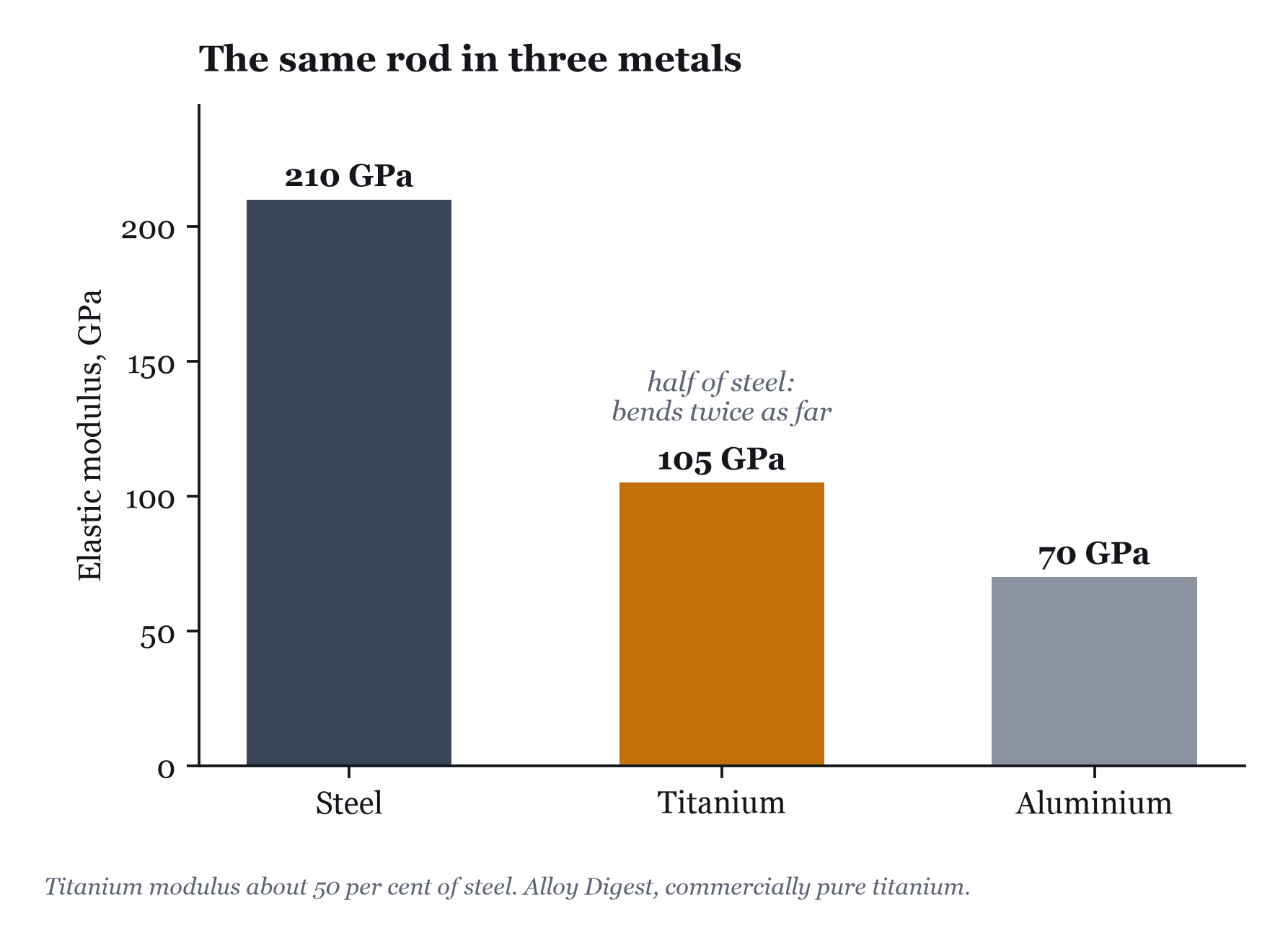
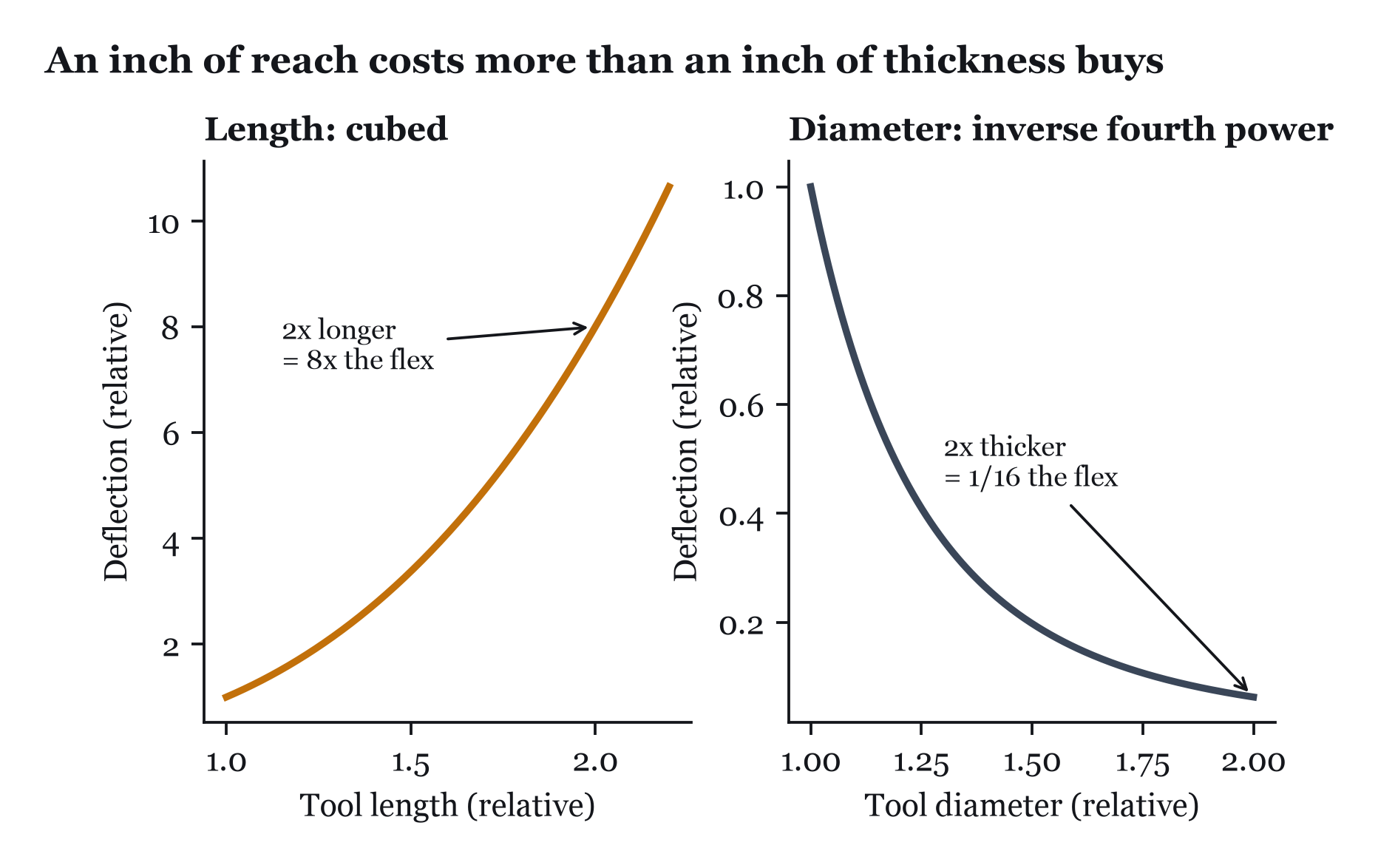
The metal in your hand obeys the same arithmetic, and over this one you have some say. A rod under load is a beam. A beam's deflection rises with the cube of its length and falls with the fourth power of its diameter.15 That is why an inch of extra reach costs you far more feel than an inch of extra thickness will buy back. Material settles the remainder. Titanium is popular for good reasons, lightness being the obvious one, at roughly fifty-six per cent the density of steel. But its modulus of elasticity is only about half that of steel.14 A titanium rod of identical length and diameter bends about twice as far under the same hand. Neither is a fault, and neither is a virtue. It is a trade. A stiffer tool delivers more of what you give it to the tip, and tells you less on the way back. A springier tool holds more of your effort in reserve, and reports more of what the panel is doing with it. Choose deliberately. Understand this: when you change tool material you have not changed the handle. You have changed the instrument.
1.3Where the lines fall
So where do the lines fall? The material ones can be stated plainly, because they come out of numbers rather than opinion. Steel to aluminium is a threshold: at comparable strength the same damage returns about three times harder. Mild steel to high-strength steel is a threshold of much the same size, and nothing in the panel's colour, weight or sound announces it. Thickness is a threshold, and it runs the way most men guess wrong: springback rises as the sheet grows thinner,10 so the modern thin panel fights the finish harder than the old thick one in the very same alloy. Whether the grade was bake-hardened is a threshold. And these do not queue politely to be dealt with one at a time. They compound. A thin, high-strength, bake-hardened aluminium closure is not one step harder than a steel door from the nineteen-nineties. It is several steps multiplied together. Where you draw your own lines at the bench is yours to set. I will not pretend a book can do it for you. But you ought to know which side of each line you stand on before you open your mouth about price.
Which brings us to money, and to the thing this trade gets wrong most consistently. We price by diameter. A coin, a golf ball, a palm: a matrix that turns width into a number. But diameter is a property of the damage, and nearly everything that determines the work is a property of the panel. Consider two dents of identical width, identical depth, identical access. One sits in a soft steel fender from 2003. The other sits in a thin bake-hardened aluminium door built this year. They are not the same job. They will not take the same time. They cannot both be priced correctly by a chart that cannot tell them apart. If you are working aluminium, high-strength closures, thin modern gauges, any panel where the return fights you all the way to the finish, you are doing materially harder work. You should be paid for it. Neither the customer nor the insurer can see any of this, which is precisely why the burden of saying it falls on you: in plain words, with the reason attached, before you begin. A technician who can explain why this door costs more than that door has a business. A technician who simply charges more has an argument.
A technician who can explain why this door costs more than that door has a business. A technician who simply charges more has an argument.
Now the half nobody in our trade says aloud: it cuts the other way as well. There are jobs the matrix overprices. A large, shallow dent in a thick, soft steel panel, with clean access and no body line running through it, is not a hard repair, however impressive its diameter looks on a chart. Older vehicles. Inner panels. Low-crown areas. Forgiving alloys. These go faster and better than their measured size suggests, and if you priced them with a tape measure you overcharged an honest man. Say so, and charge accordingly. Partly because it is honest, and honesty is the cheapest marketing there is. But mostly because a pricing argument that only ever discovers reasons to charge more is not a pricing argument at all. It is a markup wearing a lab coat. Customers work that out faster than we like to believe. The credibility you need on the hard jobs is bought on the easy ones.
So: two metals, and in each of them one relationship that matters more than the rest. In the panel it is strength over stiffness, because that ratio is what comes back at you. Thirty years of manufacturing has been raising the top of that fraction and leaving the bottom where it always was. In the tool it is the modulus you chose and the geometry you are holding: between them they decide how much of your intention reaches the tip, and how much of the panel's answer reaches your hand. The thresholds are set by material, by gauge, by process. Never by the width of the damage. The price sheet this trade has leaned on for forty years measures the one variable that has scarcely changed, while ignoring every variable that has. Learn what the panel is before you quote it. Then charge what the metal costs, in both directions.
Notes
- Ranges and strengthening mechanisms for the steel families named here follow the standard automotive classification. Geoff Davies, Materials for Automobile Bodies, 2nd ed. (Oxford: Butterworth-Heinemann), table 3.9, “High-strength Steel Grades Commonly Available in Europe,” 118. ↩
- “Carbon levels are typically 0.03–0.05% but for ultra-deep-drawing coated or high-strength grades, where extra drawability is required, this is reduced to less than 0.0002%. This is achieved by vacuum degassing of the molten steel prior to casting… Additions of titanium or niobium ensure that interstitial elements such as carbon and nitrogen are reduced to extremely low levels.” Davies, Materials for Automobile Bodies, 103. ↩
- “At yield/proof-stress levels down to 120 N/mm² they can depart from the accepted design minimum of 140 N/mm².” Davies, Materials for Automobile Bodies, 102. ↩
- Bake-hardenable grades are specified for exterior panels to give a “balance of stamp formability and dent resistance.” Y. L. He, “Conventional High-Strength Automotive Steels,” in ASM Handbook, vol. 1 (ASM International, 2026). ↩
- “The stress levels given by Japanese designers are for ultimate tensile strength (UTS) and not yield stress. Thus, higher levels are referred to for some grades of steel initially developed in Japan, e.g. a level of 600 MPa for DP600, whereas the equivalent European stress level for the same material would be lower, i.e. a yield stress of 340 MPa.” Davies, Materials for Automobile Bodies, 102. ↩
- “The 5xxx ‘wrought’ series alloys have traditionally been used for panel production… due to their relatively low cost (three times that of zinc-coated steel (ZCS), compared with five times ZCS for 6xxx) and formability. The main concern has been that they are prone to stretcher-strain markings or Lüders bands… The 6xxx series alloys are characterized by higher yield strength than Al-Mg alloys and are heat-treatable, imparting a significant degree of bake hardening at temperatures approaching 200 °C… the 6xxx series alloys (6016 in particular) are proving most versatile.” Davies, Materials for Automobile Bodies, 129. ↩
- “Magnesium is the lightest of all the engineering metals, having a density of only 1.74 g/cc. It is 35% lighter than aluminum and over four times lighter than steel.” Davies, Materials for Automobile Bodies, 132. ↩
- “Demand has led to the development of higher strength, thinner gauge automotive sheet materials that are being used to reduce vehicle weight, and thus improve fuel efficiency.” D. Thomas et al., “Static and Dynamic Denting of Paint Baked AA6111 Panels,” SAE Transactions 110 (2001): 993–1006. ↩
- Material models used for springback computation give low-strength (interstitial-free) steel a yield stress of 150 MPa with E = 210 GPa, and high-strength aluminium (7075-T6) 500 MPa with E = 70 GPa; the accompanying table lists low- and high-strength steel at 150 and 500 MPa respectively, both at E = 210 GPa. R. H. Wagoner, J. F. Wang and M. Li, “Springback,” in ASM Handbook, vol. 14B, Metalworking: Sheet Forming, ed. S. L. Semiatin (ASM International, 2006), 733–755, table 1 and eqs. 26–27. ↩
- “Springback is proportional to strength/stiffness, that is, σ₀/E. Springback is inversely proportional to sheet thickness.” Wagoner, Wang and Li, “Springback,” eq. 9. ↩
- “Aluminum sheet of comparable strength to a steel alloy exhibits springback approximately three times greater, because its elastic modulus is approximately ⅓ as large as that of steel.” Wagoner, Wang and Li, “Springback.” ↩
- “Bake hardening is the increase in strength of prestrained steel resulting from a combination of work hardening during part forming and strain aging during the subsequent paint/bake cycle (177 °C, or 350 °F, for 30 min)… The bake-hardening mechanism involves the diffusion of carbon and nitrogen atoms to form an atmosphere around dislocations generated by prestraining or forming. Blocking and pinning dislocations… result in strengthening the steel. Bake hardening makes a formed steel panel stronger after baking than after forming.” “Attributes of Advanced High-Strength Steels,” in Advanced High-Strength Steels: Science, Technology, and Applications (Materials Park, OH: ASM International, 2013). ↩
- Elastic modulus is a property of the alloy family rather than of its heat treatment: every steel falls within a few per cent of the same figure, near 200 GPa. That is why no steel rod can be made stiffer by hardening it. Figures given in this section are rounded handbook values for the families named. ↩
- Commercially pure titanium: “low density (about 56% of steel); low modulus of elasticity (about 50% of steel).” Alloy Digest datasheet, ASM International. [Precise datasheet number to be confirmed.] ↩
- For a cantilever of circular section, deflection δ = FL³/3EI with second moment of area I = πd⁴/64; deflection therefore scales with the cube of length and the inverse fourth power of diameter. Standard beam theory; see chapter eight. ↩