
Chapter Two
The Electronics
The last chapter was about what the panel is made of. This one is about what is behind it, beside it, and inside it. Every panel you remove is now the lid on a circuit. That was not true when this trade began, it was barely true twenty years ago, and it is comprehensively true today. A modern door is a sealed chamber with a computer in it. A modern roof rail is a loaded pyrotechnic tube with an antenna beside it. A modern bumper cover is a radar window. None of that changes how metal moves. All of it changes what you are allowed to do to reach the metal.
Every panel you remove is now the lid on a circuit.
I want to be honest about the state of the evidence before we start. There is no literature on paintless dent repair and vehicle electronics: none, in either direction. The engineering literature on crash sensing was written for people designing the sensors, and it never imagined us. The repair literature was written for collision shops replacing parts, not for a man removing a door card to reach a low. So some of what follows is sourced and some of it is the bench, and I will say which is which as we go.
2.1What is actually behind the panel
Start with a map, and then a list. These are the sensors a body technician actually meets on a modern car, zone by zone, each with what it does, what it looks like, where it lives, and how careful you need to be around it. The numbers match the map and the drawings. Every entry carries one of three ratings. Avoid means a device you must never lean on, pry against, heat, or move to reach a dent: an airbag part, a crash sensor, a high-voltage cable, or an aimed unit that is expensive to put right. Handle with care means you can work near it, but disturbing it may cost a calibration, a re-learn, or a strange fault the customer notices next week. Low risk means the consequence is small. The locations are general. Every manufacturer arranges its own car, and the only authority on a particular vehicle is that vehicle's own repair information.1
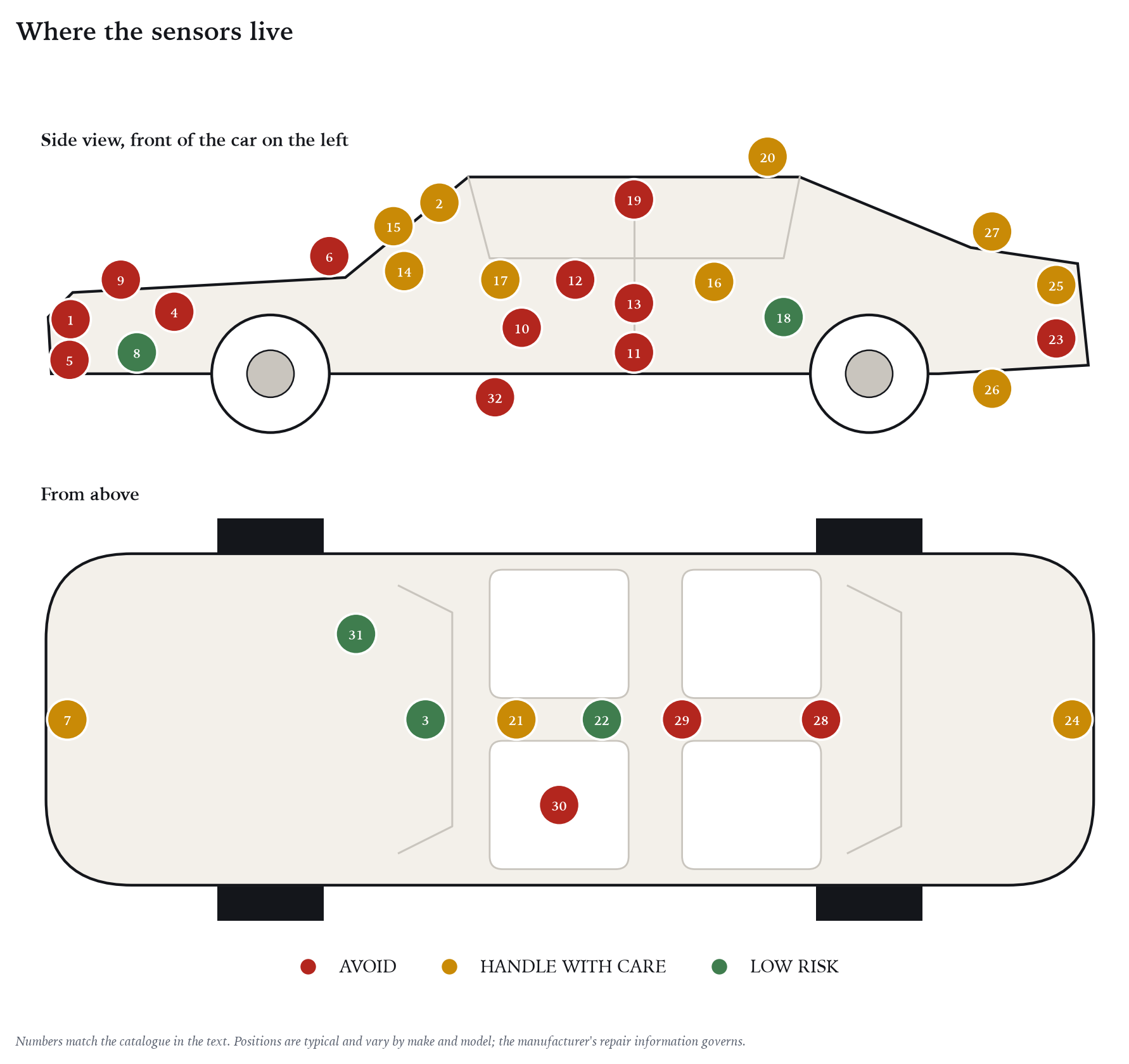
2.1.1Front of the car
- 1. Forward radaravoid · grille, emblem or lower bumper
- Runs adaptive cruise and automatic emergency braking. What it looks like: a flat plastic-faced box about the size of a paperback, often hidden behind a smooth, glossy badge that is really a radar window. It is aimed, so a knock to its bracket, a shim, or a thick refinish on the cover in front of it can move the aim or weaken the signal. Never lean a tool on it or on the panel directly in front of it.
- 2. Forward camerahandle with care · windscreen, behind the mirror
- Reads lanes and signs and feeds emergency braking. What it looks like: a black housing bonded to the inside of the glass, looking out through a clear window in the dotted black border. If the glass comes out, the bracket moves, or its wiring is strained when a headliner drops, the aim becomes a question and a calibration is owed.
- 3. Rain and light sensorlow risk · windscreen, behind the mirror
- Runs automatic wipers and headlamps. What it looks like: a small square or oval pad pressed against the glass with a clear gel. Little to lose on its own, but it shares a cover and a loom with the camera above it.
- 4. Front crash sensorsavoid · radiator support and front rails
- Tell the airbag module how hard the front has been hit. What it looks like: a small bolted plastic or metal module the size of a matchbox, with a connector and often an arrow moulded on it. The engineering literature calls this the crush zone and notes that the sensor itself may be struck, turned or torn off in a crash.2 They are mounted to be hit. They are not mounted to be leaned on.
- 5. Pedestrian-protection sensorsavoid · along the front bumper beam
- Decide whether to fire the active hood when a pedestrian is struck. What it looks like: either a thin rubber pressure tube running the width of the bumper beam, or a row of small accelerometers bolted along it. Pushing on the bumper beam from behind can load exactly the part designed to detect a body.
- 6. Active hood liftersavoid · under the hood hinges
- Pop the back of the hood up in a pedestrian strike to give a head room to stop. What it looks like: a short metal cylinder or spring canister under each hinge, with a wire to it. On many of these the actuator is pyrotechnic. A hood hinge on these cars is a loaded device: never pry at the hinge or rest a hood on it while you work the skin.
- 7. Front parking sensorshandle with care · front bumper cover
- Measure distance to obstacles when parking. What it looks like: round discs about the size of a coin, set flush in the cover with a thin ring around them and a stem behind. They read through their own face, so a dent, a crease, or extra paint around them changes what they report.
- 8. Ambient air temperature sensorlow risk · behind the grille or bumper
- Tells the car how cold the outside air is. What it looks like: a small plastic probe on a two-wire lead, clipped behind the grille. Easy to knock loose and easy to put back.
- 9. Lidar and night-vision unitsavoid · grille, bumper or roof line on some premium cars
- Build a three-dimensional picture ahead for driver assistance, or see heat at night. What it looks like: a box with a dark glass or smoked window, larger than a radar. Expensive, aimed, and calibrated. Stay well clear.

2.1.2Doors, pillars and sides
- 10. Side impact pressure sensoravoid · inside the door cavity
- Detects a side crash by the jump in air pressure inside a sealed door. What it looks like: a small puck or square module fixed to the inner door skin, with a short pipe or port facing into the cavity. It has a section of its own below, and it is the reason a door card is not trim.
- 11. Side impact acceleration sensoravoid · B-pillar base or sill
- Detects a side crash by sudden sideways movement. What it looks like: a small bolted module, usually with an arrow pointing across the car, which is the direction it senses. The literature places these calmer sensors in the passenger compartment, at the centre tunnel and the B pillar.2 The B pillar is a place you put your body weight every day. It is also, on a great many cars, a sensing location.
- 12. Side and seat airbagsavoid · outer edge of the front seats
- Protect the chest in a side crash. What it looks like: a stitched seam or small tag on the outer side of the seat back, often marked SRS or AIRBAG. Moving a seat to get a better angle means working next to it.
- 13. Seat belt pretensionersavoid · B-pillar base and seat frame
- Snatch the belt tight at the start of a crash. What it looks like: a small metal cylinder or tube beside the belt reel or buckle, with a yellow connector. It holds a charge, in a pillar you lean on.
- 14. Surround-view camerashandle with care · underneath each door mirror
- Stitch together the bird's-eye parking view. What it looks like: a small lens pod, about the size of a thumbnail, looking straight down from the mirror base. A mirror knocked out of position gives a view that no longer lines up.
- 15. Mirror modulehandle with care · door mirror
- Carries the heater, fold motor, turn signal and the blind-spot warning lamp. What it looks like: the mirror itself, with a thick loom running into the door. Removing a mirror to reach a dent means unplugging all of that, and some cars will need the camera under it recalibrated.
- 16. Capacitive door handlehandle with care · outer door handle
- Senses your hand for keyless entry. What it looks like: an ordinary handle with a hidden electrode strip inside, sometimes marked by a small ridge or dot. Wrapping, taping or clamping it can make the car think a hand is there.
- 17. Window anti-pinch sensorhandle with care · window motor inside the door
- Stops the glass if it meets a finger. What it looks like: nothing you will see directly: a magnet and a small chip inside the window motor count its turns. Keep magnets away from it, and expect that the window may need its travel re-learned after power has been cut.
- 18. Door latch and ajar switchlow risk · inside the door latch
- Tells the car the door is open. What it looks like: part of the latch, with a connector on it. Low consequence, but a door left unlatched for an hour can keep modules awake and drain the battery.

2.1.3The roof
- 19. Curtain airbagsavoid · roof rail, above the headliner
- Drop a curtain down the side windows in a crash or rollover. What it looks like: a long folded fabric sleeve clipped along the roof rail, with a cylindrical gas generator at one end. This is directly above the dents you work on a hail roof. Dropping a headliner means working alongside a live pyrotechnic device.
- 20. Shark-fin antennahandle with care · roof, towards the rear
- Houses GPS, mobile data, satellite radio and the emergency call link. What it looks like: the fin itself, bolted through the roof skin, with a coaxial cable running down a pillar. Never lever against its base when working roof dents nearby.
- 21. Sunroof motor and anti-pinchhandle with care · front edge of the roof opening
- Drives the glass and stops it on an obstruction. What it looks like: a small motor under the headliner at the front of the opening. Like the windows, it may need re-learning after the battery is disconnected.
- 22. Interior intrusion sensorlow risk · overhead console
- Part of the alarm, watching for movement in the cabin. What it looks like: a small grille in the overhead console. Leaving a door or window open while you work can set it off.
2.1.4The rear of the car
- 23. Blind-spot and rear cross-traffic radaravoid · behind the rear bumper corners
- Watch the lanes beside and behind you. What it looks like: a flat box, smaller than the forward radar, bolted inside the bumper corner. It sits right behind the quarter panel you were about to pull on. It is aimed at an angle through the bumper, so a dent, a pull, or extra paint in that corner can throw it off.
- 24. Rear parking sensorshandle with care · rear bumper cover
- The same coin-sized discs as the front, reading behind the car. The same rule: leave the cover around them as the factory made it.
- 25. Reversing camerahandle with care · tailgate or boot lid, by the handle
- Shows the view behind when reversing. What it looks like: a small lens, often tucked under the handle trim. Working the lid from inside puts your hands beside its loom.
- 26. Hands-free liftgate sensorhandle with care · under the rear bumper
- Opens the tailgate when a foot sweeps underneath. What it looks like: a long plastic strip or a pair of cables clipped inside the lower bumper. It reacts to anything close to it.
- 27. Liftgate pinch stripshandle with care · edges of the power tailgate opening
- Stop a closing tailgate that meets a hand. What it looks like: a black rubber strip along the edge of the gate that is really a switch. A crushed or kinked strip reads as an obstruction and the gate refuses to close.
- 28. Pop-up rollover barsavoid · behind the rear seats of some convertibles
- Spring up in a rollover to protect the occupants. What it looks like: two hoops or a bar sitting low behind the head restraints. They are spring or pyrotechnic, and they fire fast.

2.1.5Cabin and structure
- 29. Airbag control moduleavoid · centre tunnel, under the console
- The brain that decides which restraints fire. What it looks like: a metal box bolted flat to the floor, with bright yellow connectors. Yellow means restraint system, and those connectors are built to be hard to unplug by accident.
- 30. Occupant classification sensoravoid · passenger seat cushion
- Decides whether the passenger airbag is armed at all, based on who or what is sitting there. What it looks like: nothing visible: a mat or strain gauges under the seat. Taking out or moving a seat touches a safety decision.
- 31. Steering angle and yaw sensorslow risk · steering column and centre of the car
- Feed stability control. What it looks like: a ring on the steering column and a small module near the middle of the car. Rarely in a dent tech's way, but a battery disconnect can make some cars ask for a steering angle reset.
- 32. High-voltage battery and cablesavoid · floor pan and underbody of hybrids and electric cars
- Carry the drive power. What it looks like: thick cables in bright orange sleeving and a large flat pack under the floor. Orange means do not touch. Do not brace against the floor of an electric car, lever near an orange cable, or pierce anything one might be behind.

So the short version, for a tech in a hurry. The ones marked avoid you do not touch, lean on, heat or move, ever, because they either fire or they cost the customer a calibration they did not ask for. The ones marked handle with care you can reach past, as long as you know you owe a check before the car goes back. And before you take anything off to reach a dent, find out which of these three the part behind it is.
2.2The door is a sealed chamber
Now the finding that changed how I think about a door card, and the single most useful thing in this chapter. One family of side impact sensor does not measure acceleration at all. It measures air pressure. The sensor sits inside the door structure, and the engineering description of how it works is this: the door cavity functions as a closed chamber, which loses volume and gains pressure at the moment of impact. The system watches for a pressure rise crossing a threshold, in the order of tens of millibars, within a few milliseconds.3

Read that again with a trim tool in your hand. The sensor works because the cavity is sealed. The same source notes that the pressure rise falls away again as air leaks out, or as a fracture opens the cavity.3 A cavity that leaks is a cavity whose pressure signal is changed.
So the vapour barrier behind your door card is not weather protection with a safety sticker on it. On a car with pressure based side sensing, the seal is part of the sensing system. Peel it back carelessly, tear it, trap it, or press it down on adhesive that has picked up dust and no longer seals, and you have altered the chamber the sensor is listening to. I cannot tell you how large that effect is, and I will not pretend to: nobody has measured it for our trade. I can tell you that the mechanism is published, that it depends on the cavity being closed, and that the man most likely to open that cavity and close it again badly is a dent technician in a hurry.
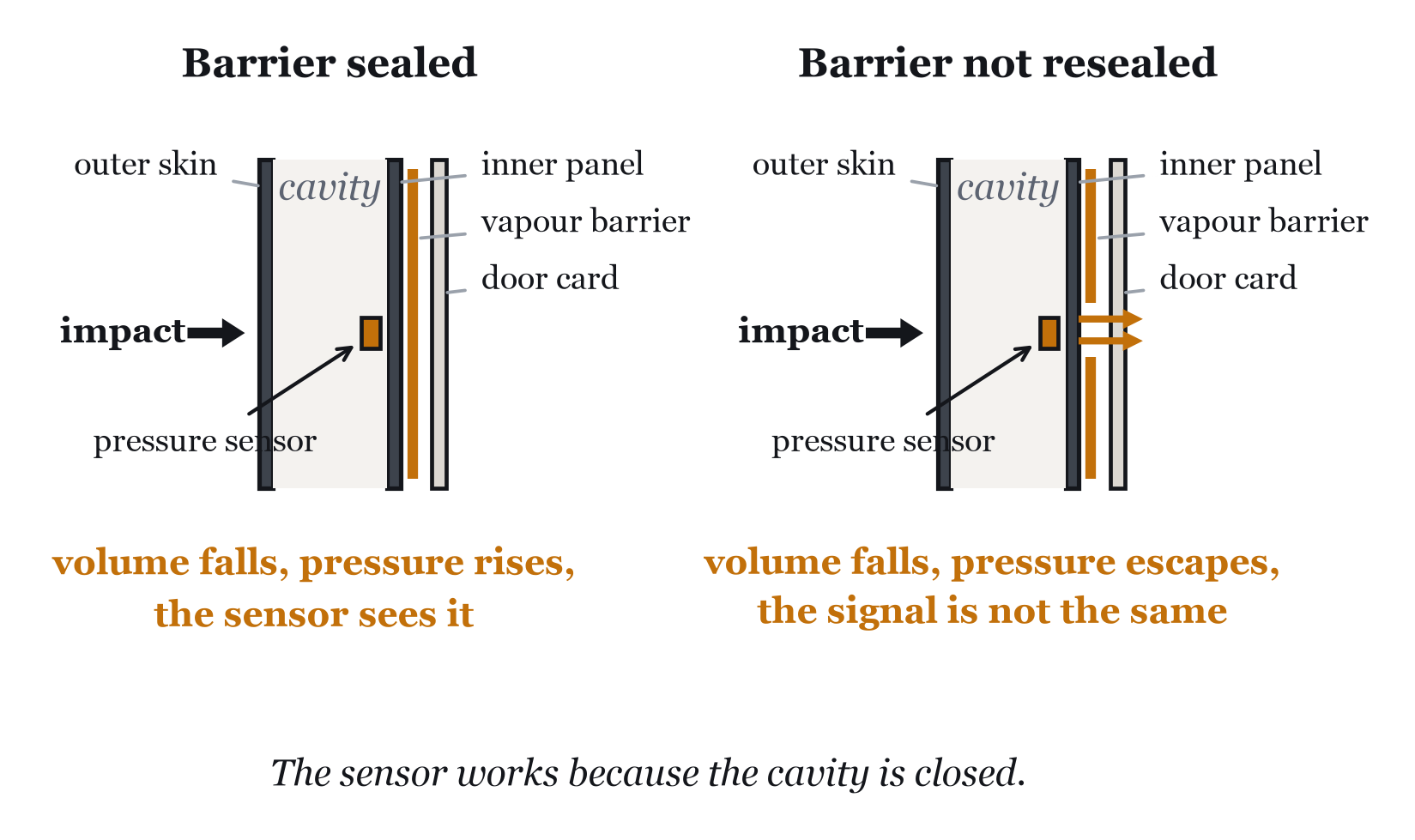
The vapour barrier is not weather protection. On some cars it is part of a safety system, and you are the last person to touch it.
The practical rule is short. Take the barrier off in one piece. Keep it clean. Put it back on its original adhesive line, sealed the whole way round, and replace the adhesive when it will not seal. That is five extra minutes. It is also the difference between reassembling a door and reassembling a sensor housing.
2.3What must never be disturbed
Some things in a modern car are not a question of skill or care. They are a question of whether you touch them at all.
- Pyrotechnic devicescurtain, side, front, pretensioners
- Inflators are explosive charges. They are not rated for being levered against, drilled near, heated, or supported on. If reaching a dent requires you to move an airbag, the honest answer is that the dent requires a different route or a different trade.
- Seat belt pretensionersB pillar, seat frame
- The same thing, in a place you lean on. There is a charge in that pillar trim.
- High voltage cableorange, on any hybrid or electric car
- Orange means do not touch. Do not lever against it, do not route a tool past it, do not clamp to it, do not pierce anything an orange cable might be behind. On an electric car the pack is usually the floor, and the floor is where you brace.
- Airbag control module connectorscentre tunnel
- Yellow connectors are the restraint system. They are designed to be difficult to disconnect by accident, and that is the whole idea.
2.4Heat, magnets, and induction
Three of our ordinary habits deserve rethinking around electronics, and only one of them is obvious.
Heat is the obvious one. A heat gun held on a panel is heating whatever is behind the panel too: a loom, a module housing, an inflator, a sensor body, an adhesive bond holding a camera bracket to glass. Controlled panel temperature is the goal, as chapter twelve says. A hot spot you cannot see the back of is not controlled.
Induction is the one the trade underestimates. An induction heater works by driving eddy currents in metal, and it does not distinguish between the metal you meant and the metal behind it. Brackets, clips, wiring shields and sensor bodies are all metal. Keep it off anything you cannot see the far side of, and keep it away from glass-mounted sensors, restraint components and modules entirely.

Magnets are the quiet one. We use them for boards, for lights, for holding trim, for parking a tool on a fender. A magnet is not going to wipe a modern module, and I have never seen one do so. But magnets do interact with the reed switches, hall sensors and magnetic encoders that sit in door latches, window regulators and seat position sensors. Keep them off the hardware and on the panel, which is where you wanted them anyway.
2.5What you owe when you put it back
Here is the part the trade has not caught up with. On a car built in the last decade, taking something off and putting it back is not always a null operation. Several systems learn their own geometry, and disturbing the part they are mounted to can mean they need to be told where they are again.
- Anything the camera can see pastwindscreen work, headliner drops
- Forward cameras are aimed. If the bracket moves, or the glass comes out, or the loom is strained, the aim is a question. Calibration is a scan tool and a target, not a guess.
- Blind spot radarrear bumper covers, quarter panels
- Aimed at an angle through a plastic cover. Removing and refitting the cover is normal. Deforming, over-tightening or shimming it is not.
- Ride height and steering angleanything that moved the suspension
- Rare in our work, and worth knowing about when you have lifted or jacked awkwardly.
- Stored faultsany disconnection at all
- Disconnecting a battery, a module, or a connector can log a code and can clear learned values. A code you caused and did not clear becomes a code the next shop bills someone for.
Which brings me to the habit I would most like this trade to adopt, and it takes four minutes. Scan the car before you touch it, and scan it again when you are finished. Keep both. If the car arrived with eleven stored faults, that is now documented and it is not your conversation. If it left with twelve, you know which one is yours while the car is still in front of you, which is the only time that knowledge is cheap.
A scan before and a scan after costs four minutes. Finding out later costs a panel, a customer, or a week.
2.6The electric car
Electric cars change three things for us and leave the rest alone. The metal is the same argument, sometimes with more aluminium. But the floor is a battery pack, so the places you brace and the places you lie are no longer neutral. The roof on many is a single large glass or aluminium panel with the antenna array beneath it. And the whole vehicle is awake far more of the time than a combustion car, which means circuits are live when you assume they are asleep.
The rule I work to is simple and slightly boring. Do not brace against the floor of an electric car. Do not run a tool where an orange cable might be. If the car needs to be powered down to work safely, that is the manufacturer's procedure and not mine to invent.
2.7The honest summary
None of this makes you an electrical technician, and it is not meant to. It makes you a metalworker who knows what he is reaching past. The trade I entered could remove any trim panel on any car without consequence, because behind the trim there was a window regulator and some foam. That trade is gone, in exactly the way the woodworking trade went when the all steel body arrived, and for exactly the same reason: the vehicle changed underneath the men working on it.
So learn the map. Take the barrier off in one piece and put it back sealed. Keep heat and induction away from what you cannot see the far side of. Never move a restraint component to reach a dent. Scan before and scan after. Do that, and the electronics are a constraint you work inside, the way access and paint have always been constraints. Ignore it, and sooner or later you will hand back a car that is worse in a way you cannot see and cannot polish out.
Notes
- Sensor locations, appearances and the ratings given here are a general guide drawn from the author's bench experience across makes, not from any single manufacturer. Designs change between models and model years. Before removing a panel, trim piece or component near any of these parts, consult the vehicle manufacturer's current repair information and any calibration or position statements it publishes for that vehicle; where they differ from this chapter, they govern. ↩
- “The crush zone is the portion of a vehicle that is subject to direct deformation or destruction from a collision… Crush zone pulses are volatile and oscillatory by their nature… Measurements taken near or behind the front bumper are representative of crush-zone locations… Measurement taken in the passenger compartment, such as the center tunnel or the B-pillar, are representative of non-crush zone locations.” Ching-Yao Chan, Fundamentals of Crash Sensing in Automotive Air Bag Systems (Warrendale, PA: Society of Automotive Engineers, 2000), 29–30. ↩
- “The pressure sensor is located in the interior of the door structure. The door cavity functions as a closed chamber, which experiences a decrease in volume and an increase in pressure at the time of impact. By measuring this rise in pressure, the sensor is able to differentiate severe side collisions from abusive situations or minor collisions. When the pressure exceeds a threshold, a firing signal is given… The pressure rise will eventually fall over time when air leaks out or when a fracture opens up the cavity.” Ching-Yao Chan, Fundamentals of Crash Sensing in Automotive Air Bag Systems (Warrendale, PA: Society of Automotive Engineers, 2000), 140–141, describing the method of A. Hartl et al., SAE paper 950348. The deployment threshold shown there is 34 millibars. The application of this to trim removal in paintless dent repair is mine, and is not in the source. ↩