
Chapter Thirteen
The PDR5 Framework
Ask ten experienced technicians how they repair a large dent and you may receive ten correct answers that are almost impossible to teach. One says: I release it first. Another says: I build the line. Another says: I just get the bulk out. A fourth says: you have to read the tension. All of them may be describing parts of the same process without possessing a shared map. The PDR5 Framework is my attempt to give that map a shape, and this chapter walks through it: five phases, what each is actually for, the two mnemonics that make the first two memorable, and the reason the last phase is the one that separates technicians from each other.
13.1The five phases
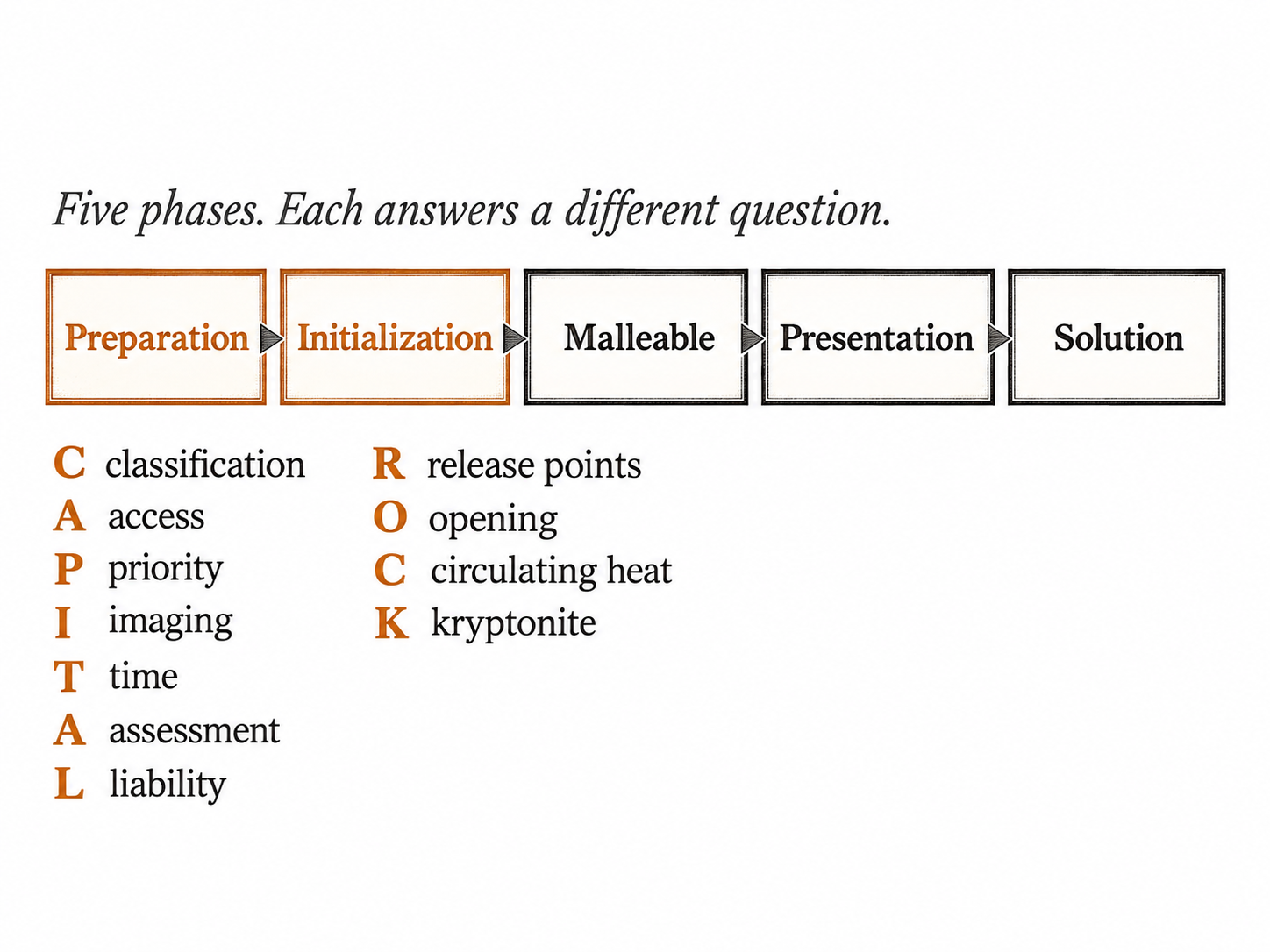
Large repairs pass through five broad phases: Preparation, Initialization, Malleable, Presentation, and Solution. A technician may not use those names. He may move between phases without noticing. He may even move backward. The value of naming them is diagnostic. When the repair goes wrong, you can ask where it went wrong, and that is better than pushing harder and hoping. Before the first phase, consider variability, because not every panel can or should be restored to the same level. Paint condition, stretching, previous damage, access, and customer expectations all matter. If you do not believe a repair can reach the standard you normally deliver, explain that before touching the vehicle. Do not hide uncertainty behind vague language. Customers tolerate limitations far better before the repair than after it.
13.2Preparation: CAPITAL
Preparation is the reading phase, and nothing has been touched yet. I use the mnemonic CAPITAL. C is classification: what kind of damage is this? A is access: how will you reach it, what must come off, is glue pulling more sensible? P is priority: where should the first meaningful action occur? I is imaging: compare the opposite side and the surrounding panel, and do not chase factory shape as though it were damage. T is time: how long is this realistically going to take? A is assessment of cost: what does the repair cost the customer, what does it cost the panel, and if another repair method is more reasonable, say so. L is liability: what risks are present, and what modifications, removals, paint risks, or access decisions need to be explained before the work begins? A good preparation phase is quiet, which is exactly why younger technicians tend to rush it. Nothing visible is happening and the customer is watching. Do not perform for the customer. Read the dent.
A good preparation phase is quiet. Do not perform for the customer. Read the dent.
13.3Initialization: ROCK
Initialization is the first contact with the problem, and I use ROCK. R is release points: identify where tension and depth suggest the repair should begin. O is opening the repair: create room for the metal to move, and do not lock it. C is circulating heat when heat is appropriate, and the purpose is controlled panel temperature rather than theatrical flame. K is kryptonite, my reminder that slow is fast and ego is dangerous, because you are not going to remove a complex dent in one heroic movement. Heat deserves caution here. I prefer controlled, continuous heat from a heat gun rather than an open flame for panel work, because the goal is consistency. Heat should serve the repair. It should not become a ritual performed because another technician once did it.
13.4Malleable
The Malleable phase is bulk movement, and this is where the young technician must resist the urge to finish. You are not yet repairing every tiny low and high. You are restoring large relationships. Use broad surfaces. Move large sections. Break the dent into manageable regions. Balance curvature. Release crown where necessary. Protect paint. Avoid creating sharp local damage while you are still trying to move acres of metal. I sometimes call broad patterned movement shadowing, because you are creating the rough form of the finished panel and the detail will come later. One panel may need to be treated as several panels, because every curvature behaves differently. A door skin with a body line, upper crown, lower flat, edge, and brace is not one uniform sheet in practical terms, and each region has different stiffness and a different relationship to the damage. Work the region that controls the others. Body lines require judgment. Sometimes the line must be rebuilt early, since it governs surrounding shape. Sometimes raising it first will lock the damage. Rules help, but the panel outranks the rule. The point of a framework is not to stop thinking. It is to tell you what to think about.
13.5Presentation
The Presentation phase is where the true repair becomes obvious. Almost anyone can make a large dent look dramatically better. The distinction between average and excellent work appears when the broad damage has become a collection of small lows, highs, waves, edges, and finish problems. This phase is slower and less impressive to watch, and it is where most of the craft lives. You are now working smaller regions together in stages, and you should not finish one tiny square completely while the surrounding panel remains far behind. Move related regions together. Refine them. Cross check them. Use more precise tips. Use metal knockdowns when appropriate. Let the geometry become finer as the defect becomes finer. This is also where enervation becomes a danger, because metal that has been worked repeatedly up and down loses some of the clean behaviour it had before you touched it, and every unnecessary correction makes the next correction harder. That is why Minimum Manipulation Contacts matters most when the repair becomes tedious. I use a simple error rule: if you make several mistakes in a row, stop and clean them up. Do not stack new decisions on top of old errors. There is also a failure mode here that has nothing to do with shape. Factory panels carry a natural texture in the way they hand light back, and a dent can be removed completely while the finishing leaves a surface that reads as polished, hammered, or unnaturally flat. Texture mismatch comes from over-pushing, over-tapping, uneven pressure, and irregular rhythm. It is corrected by consistent push patterns, balanced tap-down work, and gentle blending, rather than by more effort. The light will tell you, if you are willing to look for texture and not merely for shape. At some point you stop repairing the customer's dent and begin repairing yourself.
At some point you stop repairing the customer's dent and begin repairing yourself.
13.6Solution
The Solution phase is where you start over, which sounds strange but is essential. Move the board back. Change angles. Walk around the car. Look in natural light. Revisit the assumptions from Preparation. Recheck the release points. Use glue if it reveals something you could not attack from behind. Look from the standpoint, the crosspoint, and the ordinary viewpoints from which the customer will see the vehicle. Do not become lazy in the last mile. The greatest temptation in paintless dent repair arrives when the panel has already exceeded the customer's expectation. You know the customer will probably be delighted. You also know there are twenty more minutes of work in the panel. Those twenty minutes decide what kind of technician you are becoming. Completely finish the dent. Not because every customer can see every flaw, but because you can.
Five phases, then, and each one answering a different question. Preparation asks what this damage actually is before anything is touched, and CAPITAL is simply seven ways of not skipping that question. Initialization asks where the metal should first be allowed to move, and ROCK is the reminder that opening comes before forcing. The Malleable phase asks what the large relationships should look like, and it is finished when the panel is no longer one big problem. Presentation asks what remains, and it is where the craft actually lives, because it is where contacts start costing you more than they buy. Solution asks the only question that matters at the end: are you stopping because the work is done, or because you would like it to be? A technician who can name the phase he is in can also name the phase he went wrong in. Catching it is the whole reason for drawing the map.