
Chapter Five
The Single Solution
There is a comfortable belief in this trade that all successful roads are equally correct. If three technicians repair the same dent three different ways and all three panels look right, the argument goes, then all three methods must have been equally good. I do not believe that, and this chapter is the argument against it. What follows sets out four things: that every dent has a best available repair path, the unit in which that path should be measured, the honest limit of what returning a panel to factory can possibly mean, and the working rules that fall out of taking all of it seriously.
5.1Florida to Tennessee by way of California
Suppose I drive from Florida to Tennessee by way of California. I may still arrive in Tennessee. Nobody would therefore call California the best route. Arrival proves that a route worked. It does not prove the route was efficient. Dents are much the same, and the Single Solution Theory begins with a simple proposition: for any particular dent, under a particular set of conditions, with a particular set of available tools, there is a best possible repair path. We may never execute it perfectly. We may never even know exactly what it was. Believing that it exists changes the way we work. The best route uses the fewest necessary manipulations while still producing the highest practical quality. It wastes the least movement, introduces the least unnecessary stress, and reaches the finish without creating extra problems that must later be repaired. Young technicians tend to admire activity. Experienced technicians learn to admire economy. The best push is often the push that makes the next push unnecessary.

Arrival proves that a route worked. It does not prove the route was efficient.
5.2Minimum Manipulation Contacts
This leads to the idea of Minimum Manipulation Contacts. Every time you push, tap, pull, twist, heat, or otherwise change the panel, you have made a contact with consequences. Contacts are not free. They move metal, alter tension, affect finish, create tool flex, and sometimes introduce errors. A perfect repair would use exactly the contacts required and no more. This is not an equation you will calculate beside a car. It is a standard of thought. Ask yourself after a repair which of your actions solved the original damage, and which of your actions solved damage you created during the repair. That question will make you better.
5.3The Initial Dual Conditions
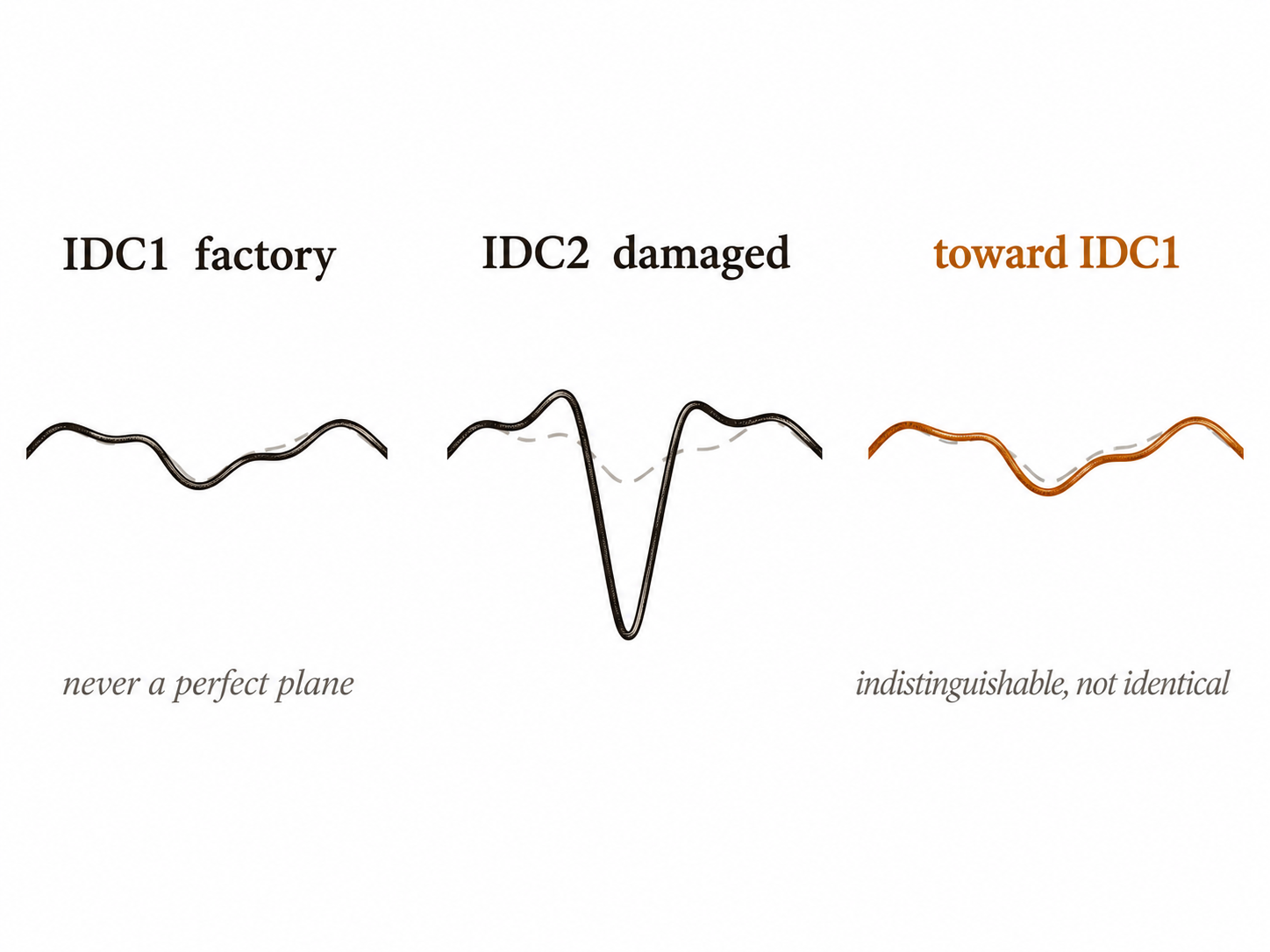
The theory also requires us to think about the panel's starting conditions, which I call the Initial Dual Conditions. IDC1 is the panel before damage. IDC2 is the panel after damage. The repair attempts to move IDC2 toward IDC1. Notice that I said toward. Factory does not mean metaphysical perfection. New panels have manufacturing variation, orange peel, slight waves, seam influences, and normal tolerances. Your job is not to create a mathematical plane that never existed. It is to restore the panel to a condition effectively indistinguishable from its pre damage state, within the limits of observation and finish. This gives us the idea of exhaustive contact: the point where further manipulation no longer improves what can reasonably be detected, and begins only to add cost or risk. Knowing when to stop is part of mastery. The last portion of a repair is often a judgment about sight, and two honest technicians can disagree about whether a panel is finished, because each man's eye, light, angle, and standard may differ. This does not mean quality is meaningless. It means the finish line must be approached deliberately rather than assumed.
5.4Two working rules
Two working rules follow naturally. The first is that large dents must become small dents. You do not repair a large complex dent in one act. You divide it into manageable regions and move those regions in connected, balanced stages. If you raise one area too far while neighbouring areas remain locked, you have not simplified the problem. You have created several new ones. The art is not in breaking the dent apart. It is in keeping the parts related. The second rule is that every repair must remain balanced and must avoid locking the panel, and sometimes this means deliberately opening a dent. A young technician sees a low and wants it smaller immediately. An experienced technician may make part of the damage appear larger for a moment, because he is releasing the path the metal must travel. That can feel backward until you understand it. If a doorway is blocked by furniture, pushing harder on the door is not progress. You first move what is blocking the doorway. Metal behaves differently, but the logic is similar. A locked dent often needs freedom before it needs force. There is a stronger version of this rule, and it is the one I would have a student memorise first. A repair runs the damage backwards. If the impact displaced metal outward, drove force along the strain paths, and collapsed the centre, then the repair releases the crown tension, corrects the strain paths and ridges, and lifts the low last. Restoring a form means reversing the sequence that destroyed it,1 and working out of that order is how you manufacture texture, high spots, and distortion that were never in the original damage. Older technicians put it more briefly than I have: slow the metal down before you push it up.
A repair runs the damage backwards. Slow the metal down before you push it up.
5.5The rules of the bench
This is where the rules of the bench become useful, and they divide naturally into seeing and pushing. On seeing: if you cannot see it, you cannot fix it. If you can see it, repair it from as many useful angles as possible. Do not push when you do not know where your tool tip is. Find the tip and make accurate contacts. On pushing: use the largest practical tip when moving broad areas, because fine tips concentrate force and broad tips distribute it. Do not allow mistakes to accumulate. If you create several pushing or tapping errors, clean them up before continuing. The exact number may change with experience, but the principle never does, because errors compound. Work bulk damage in balanced portions. Release before you crown. Rebuild the body line when the surrounding metal is ready to support it. Work creases along their path. If a dent refuses reasonable force, do not immediately become stronger. Reconsider what is locking it.
5.6Slow is fast
One of the best lessons in this entire trade is that slow is fast. Young technicians hear that and think it is a motivational phrase. It is not. It is an economic observation. The first ten minutes of a repair can save or cost the next two hours. A rushed push creates a high. The high requires a tap. The tap creates a low beside it. The low is raised with a sharp tip. The tip marks the finish. Suddenly you are no longer repairing the customer's dent. You are repairing a chain of decisions that began because you wanted to save thirty seconds. Slow is fast because accuracy prevents debt. There is a larger lesson here too: a perfect tool with terrible leverage is often worse than an imperfect tool with excellent leverage. Technicians love equipment, because equipment is easy to buy. Geometry cannot be bought. It must be understood.
So the position this chapter has been building toward is this. Arrival is not proof of efficiency, and the belief that every road is equal is the belief that prevents a man from ever finding a better one. If a best path exists, then contacts are the currency you spend looking for it, and every contact you did not need was paid for out of the same account. The target you are moving toward is not perfection but a real and imperfect factory condition, which is why knowing where to stop is a skill rather than a failure of nerve. Large damage becomes small damage that stays related to itself. Locked metal needs freedom before force. Haste at the beginning is simply borrowing time you will repay with interest at the end. You will be remembered by the finished panel, not by the sophistication of the tool cart beside it.
Notes
- That restoring a form requires reversing the sequence of its deformation is a standing principle of the metal-shaping literature. A. Steines, Moving Metal: The Art of Chasing and Repoussé (Huntingdon, PA: Blue Moon Press, 2001), 38–41; F. Sargent, The Key to Metal Bumping (Los Angeles: Auto Body Publishing), 31–35. ↩