
Chapter Fourteen
Minimum Manipulation
There is, in principle, a mathematically perfect repair for every dent, and none of us will ever make it. The impossibility is no reason to ignore the idea. It is the reason to have it. Minimum Manipulation Contacts is the theory underneath the framework, and it asks what we are optimizing when we become better. This chapter answers that in three moves: it establishes the contact as the unit of the work, it explains why metal is complicated without being lawless, and it argues that what we call instinct is something far more useful than mystery.
14.1Neither speed nor quality alone
Speed alone is not the answer, because a fast poor repair is not mastery. Quality alone is not enough either, if it requires endless unnecessary movement. The goal is the highest practical quality through the smallest necessary sequence of contacts. Every push and tap spends something. Some of that spending becomes permanent movement in the direction you wanted. Some becomes elastic deflection and returns. Some becomes stored energy in the tool. Some disappears into the fulcrum, the brace, the trim, or your own body position. And some becomes error. A master technician is not merely stronger or faster. He wastes less. That is why I think of the contact as the basic unit of the repair.
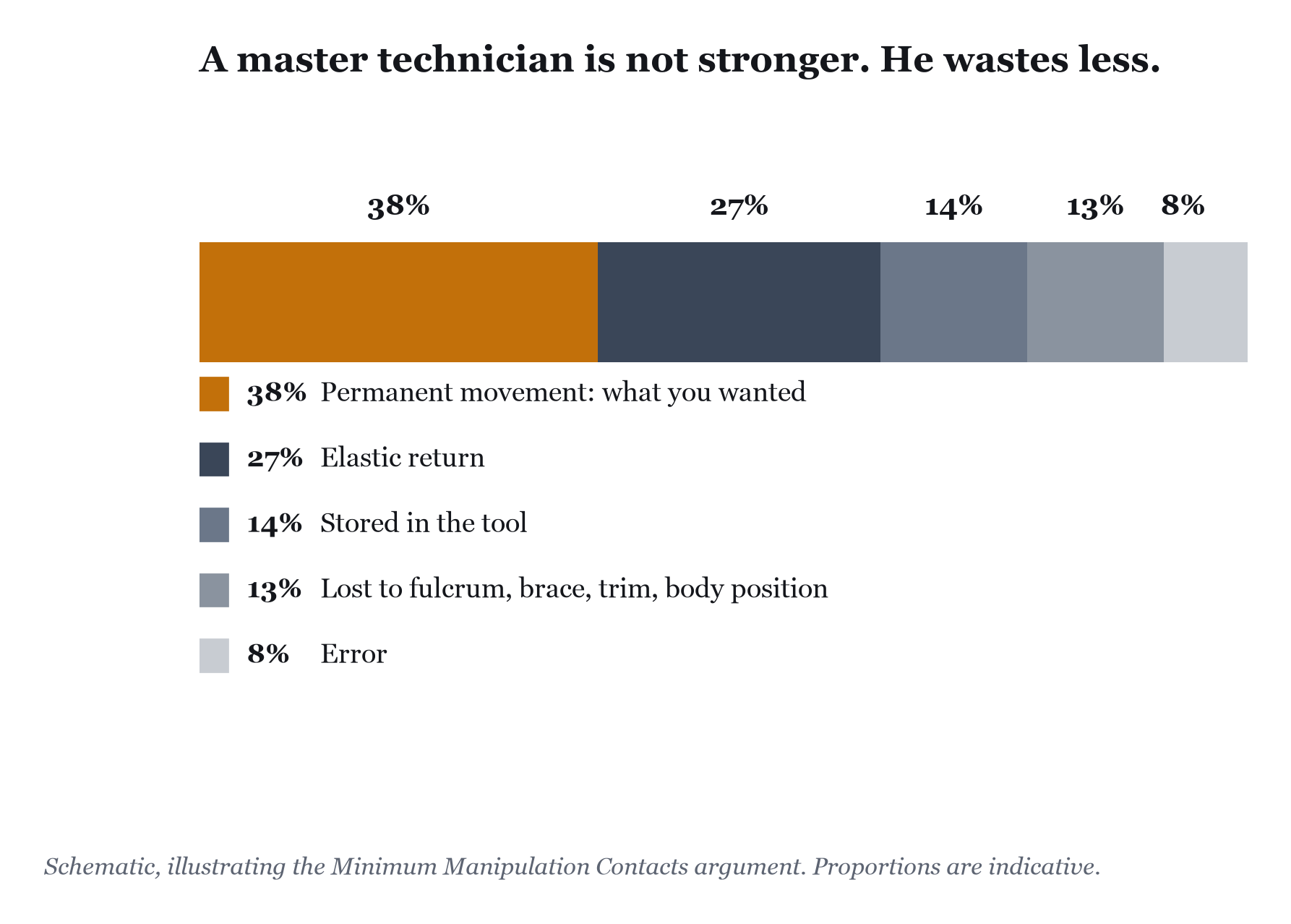
A master technician is not merely stronger or faster. He wastes less.
14.2IDC1, IDC2, and why two panels differ
The panel begins in IDC1, its pre damage condition, and the impact produces IDC2. Your work attempts to return the system toward the first state, but the path is sensitive to the exact condition in which you found it. Here chaos theory provides a useful comparison. Chaotic does not mean random. A chaotic system can follow rules while being extremely sensitive to starting conditions, so tiny differences early can produce large differences later, and dents behave much like that in practice. Two apparently similar panels can respond differently because one has a slightly different brace, paint history, temperature, alloy, curvature, access angle, or impact path. The system is not lawless. It is simply complex, and experienced technicians become good at predicting that complexity.
14.3Premonition Minimum Manipulation Contacts
I call the advanced form Premonition Minimum Manipulation Contacts, or PMMC, and the name describes what happens when a technician anticipates the likely effect of a contact before consciously reasoning through it. People often call this art, and there is art in the trade, certainly. Much of what we label intuition is accumulated data: the technician has seen similar reactions thousands of times, and his brain recognizes the pattern before he can narrate the recognition. That is why an older technician may look at a dent for two seconds and know where he wants to begin. The young technician thinks he guessed. He did not guess. He remembered at speed. This is encouraging, because it means instinct can be cultivated. You do not need to be born with a mystical relationship to sheet metal. You need to pay attention to consequences. After every significant push, ask what changed. Did the origin rise, or did the crown merely relax around it? Has another region tightened, or the tool flexed, or the brace shifted under you? Is the reflection better from one angle and worse from another? The technician who asks those questions is collecting useful data. The technician who merely keeps pushing is collecting hours.
14.4What measurement would show
If every push could be measured and every resulting change recorded, patterns would emerge. I do not claim that we currently possess a practical equation capable of repairing dents for us, because we do not. MMC is a principle, not a calculator. But principles matter because they direct attention. When you believe contacts have cost, you become conservative with them. When you believe patterns can be learned, you study your own work. When you believe intuition is compressed experience, you stop worshiping instinct and start examining it. A craft becomes teachable in exactly this way. One day machines may become extraordinarily capable at this work, because anything that can be measured, classified, and predicted can eventually be modeled. I do not regard that possibility as an insult to technicians. I regard it as evidence that our craft contains more order than we have bothered to write down.
So the contact is the unit. Complexity is not the same thing as randomness. And instinct is compressed experience rather than a gift. Taken together those three claims turn a trade that has always described itself in terms of feel into something that can be examined, argued about, corrected, and handed on. The man who understands why he pushes where he pushes has something to pass on. The man who only knows that his hand works has knowledge that may die with him.