
Chapter Ten
Pulling from the Outside
Everything to this point has quietly assumed that you can get behind the panel. Often you cannot. Roof rails. Quarter panels. Sail panels. The areas around a rear hatch. The backside is closed, or braced, or full of things that must not be disturbed. This chapter is about working from the other direction, lifting metal from the painted side with adhesive, and about four things in particular: what the method actually is, what a pull genuinely does as opposed to what beginners expect it to do, what it risks, and why it is not a shortcut but a different opening move in the same game.
10.1What glue pulling is
Glue pulling bonds a plastic tab to the paint and uses the strength of that bond to lift the low from outside. It is not a separate craft and should never be taught as one. It moves metal along the same strain paths, obeys the same rules about crowns and order, and is read in the same light as everything else. The craft in it lives in small decisions: choosing the tab whose size and shape suit the damage, spreading the adhesive evenly rather than generously, giving it the cure time it actually needs instead of the cure time you have patience for, and choosing between a mini lifter and a slide hammer according to what you want the panel to feel. None of that is exotic. It is the same discipline applied through a different opening.
10.2What a pull reveals
Now the part that surprises every student. A glue pull rarely finishes a dent. What it does is reveal the structure underneath. You should expect the low to rise only partially. You should expect new crowns to form around the lifted area, the metal to tighten in places you did not predict, high spots to appear, and the whole dent to shift off centre. Beginners read that list as a catalogue of failures. It is nothing of the kind. It is the panel redistributing tension, which is exactly what you asked it to do when you pulled. So evaluate every pull in the light before you decide the next one, and ask the same four questions each time. Is the dent centred? Are more pulls needed? Must a crown be released first? Is the panel ready for tool work? A technician who pulls and looks is working. A technician who pulls and pulls again is hoping.

A technician who pulls and looks is working. A technician who pulls and pulls again is hoping.
10.3The one risk unlike the others
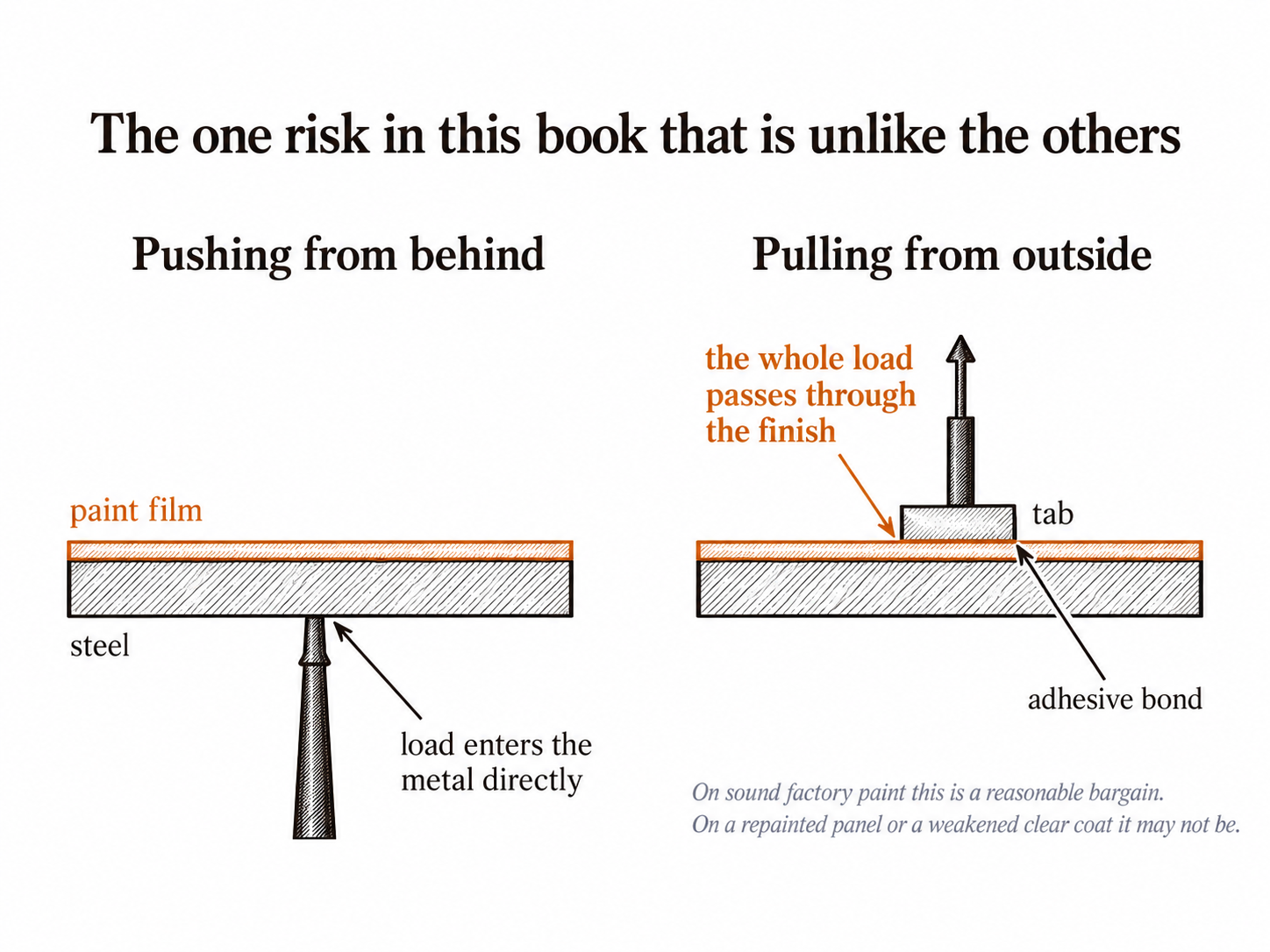
The risk deserves stating plainly rather than in the small print, because it is unlike any other risk in this trade. When you pull, you are not working through the paint. You are pulling on it. The adhesive grips the finish, and the finish must carry the whole load of lifting the metal. On original factory paint in good condition that is usually a reasonable bargain. On a repainted panel, or one whose clear coat has been weakened by age or by a previous repair, it may not be, because coatings respond differently to tension and can delaminate if they are stressed past the limit of their adhesion.1 The one thing this entire craft exists to preserve is the thing you are now hanging weight from. Look at the finish before you commit. If there is doubt, say so to the customer before the tab goes on, rather than afterwards.
10.4Pull and push together
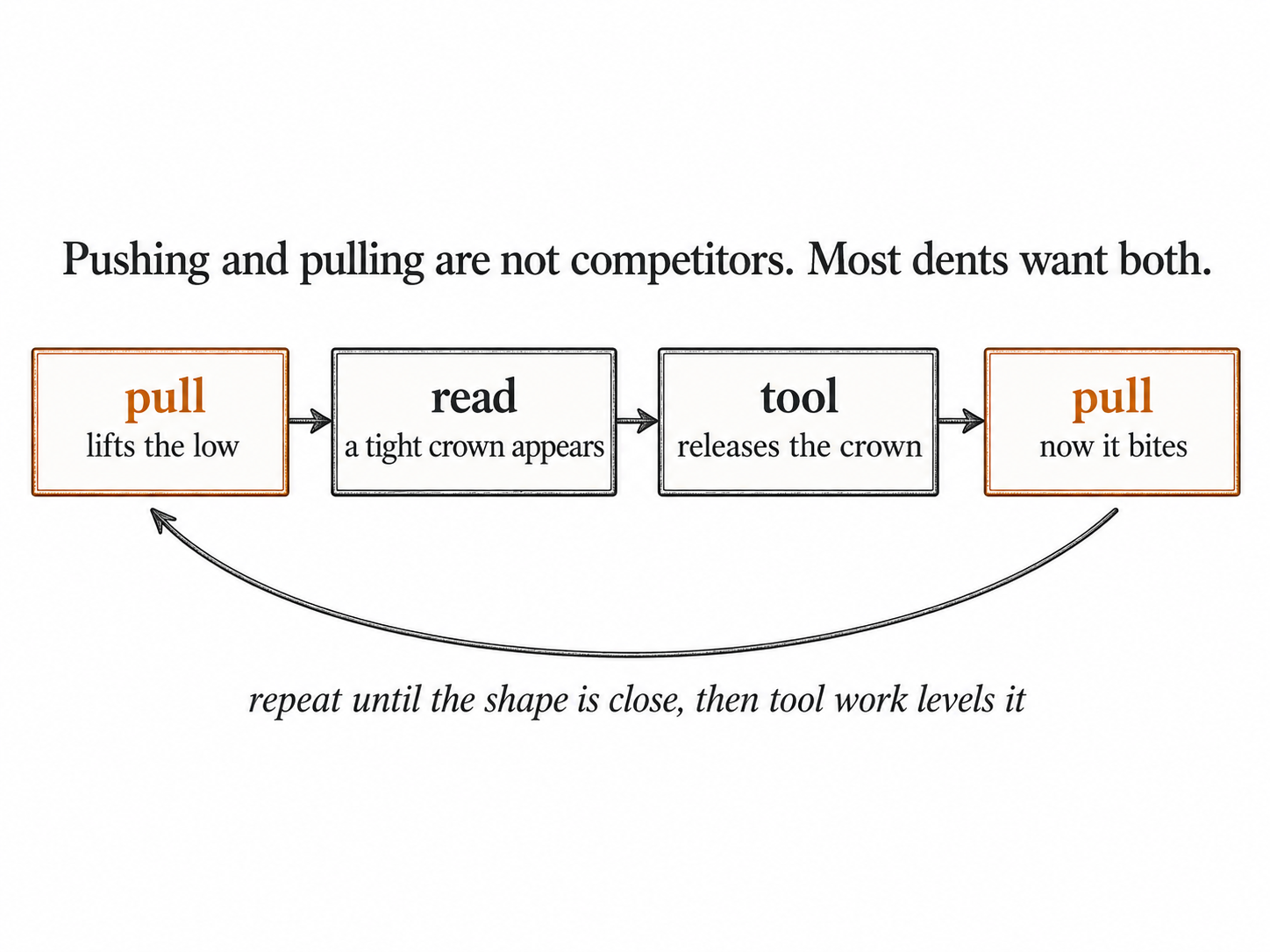
Pulling and pushing are not competitors, and it does the student real harm to frame them that way. Most substantial dents want both. A pull lifts the low far enough to expose a tight crown. A tool releases that crown so the next pull can bite. Further pulls refine the shape. Tool work completes the final levelling. Learn the two together, early, as one method with two directions of approach rather than as a traditional skill and a modern substitute for it. The technician who regards glue as cheating will be beaten on access. The technician who regards it as a replacement for understanding metal will be beaten on everything else.
So glue is neither the lazy option nor the thing that made skill unnecessary. It is access by another route, and the rules do not soften because the tool changed hands. See it before you move it. Relieve the crown before you chase the low. Read the panel after every contact. Never forget what you have chosen to hang the load from. Used well it opens panels that were once written off. Used carelessly it puts the finish it was brought in to save at more direct risk than anything else in this book.
Notes
- Coatings under tension do not behave as the substrate does; adhesion failure and delamination are the governing risks when load is applied through a paint film rather than to the metal beneath it. See G. Davies, Materials for Automobile Bodies (Oxford: Butterworth-Heinemann), on coating systems and adhesion. ↩