Chapter Twelve
Heat
Watch a row of technicians long enough and you will see a man take an open torch to a quarter panel. He waves the flame across it for a minute or two, sets the torch down, picks up a rod, goes in behind the panel, and pushes. He believes the heat has made the metal willing. It has not. By the time his tip found the low, most of what he put in had already gone back into the air, and the part that remained was never doing the thing he thought it was doing anyway. This chapter is about heat: what it genuinely does at the temperatures we actually work at, why the torch is a ritual rather than a method, why aluminium seems to shrug it off, how to use it properly on a panel and on a tool, and the adhesives behind the panel that decide, more often than most technicians realise, whether the dent was ever going to move.
He believes the heat has made the metal willing. It has not.
12.1The arithmetic of the torch
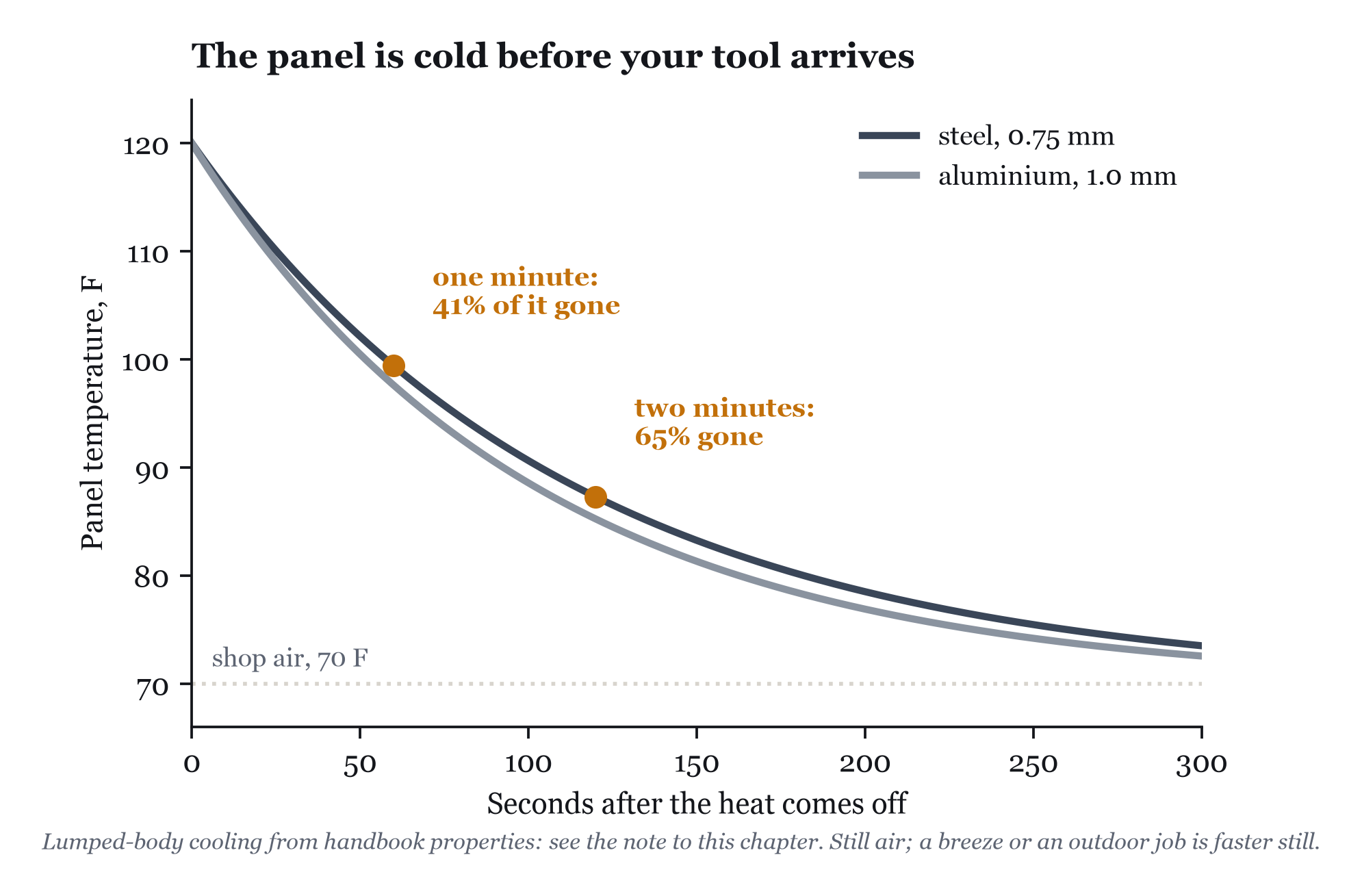
Start with the thing nobody measures. A body panel is a very thin sheet with a great deal of surface area, which is the worst possible shape for holding heat. You can put a number on how fast it loses it. A steel skin three quarters of a millimetre thick, cooling to still shop air from both faces, has a time constant of about one hundred and thirteen seconds.1 That is the time it takes to shed roughly two thirds of however much you raised it above the room.
Put that in working terms. Say you got the panel to a hundred and twenty degrees Fahrenheit in a seventy degree shop. Thirty seconds later, while you are still setting your light, it is at a hundred and eight. One minute later, as your rod finds the brace, it is at ninety-nine: you have lost two fifths of the heat before you have made a single contact. At two minutes it is at eighty-seven. At five minutes it is at seventy-three, which is to say it is a cold panel that somebody waved a flame at.
12.1.1And the flame never got it there
That is the generous version, because it assumes the torch heated the panel evenly in the first place. It did not. A flame heats a spot, and a spot on a sheet is not a heated panel: it is a small hot region bleeding sideways into a large cold one, in a material designed to conduct. The torch is not too weak. It is the wrong shape for the job, and so is the way it is used: briefly, at a point, and then removed. So the honest verdict on the passed flame is the one Paul has given for years, now with the arithmetic under it. It is a placebo. It survives because the panel did eventually come up, and the man holding the rod credited the flame instead of his hands.
There is one honest exception, and it is narrower than the men who rely on it believe. Working outdoors in genuine cold, a panel can sit well below the temperature at which anything behaves normally, and a brief pass of flame will lift it a little: not to make the metal willing, but to get it off the bottom. That is raising a cold panel toward room temperature, which is a different job from warming a panel for the work, and it buys you the same two minutes as everything else in this chapter. If the cold is the problem, the answer is still a gun and a number, and the cold merely means you will be reaching for them more often.
12.2Why aluminium seems to refuse it
Technicians say aluminium resists heat. The observation is real and the word is wrong, and the correct word explains what to do about it. Aluminium does not resist heat. Aluminium carries it away. Thermal diffusivity is the property that governs how fast heat spreads through a material, and aluminium's is about seven times steel's.2 Work that through and the practical figure falls out: in ten seconds, heat from a single spot spreads about twelve millimetres through steel and about thirty-one through aluminium.
So when you hold a flame on one place on an aluminium door, the heat runs out of that place two and a half times further, in the same time, than it would in steel. The spot never builds. You conclude the metal is refusing you. It is not refusing you. It is distributing you. The consequence at the panel is simple: on aluminium, heat must be applied over an area and kept there, because any attempt to concentrate it is a race you lose against the metal's own conductivity.
Aluminium does not resist heat. Aluminium carries it away. You are not being refused. You are being distributed.
12.3What the heat is actually doing
Now the part of this chapter that I expect to be argued with, and the part I am most confident about. We have always assumed that warming a panel softens the metal. At the temperatures this trade actually uses, it does not.
12.3.1The temperature ladder
Set the numbers on a ladder and the case makes itself. A comfortable working panel is a hundred and ten to a hundred and twenty degrees Fahrenheit, and a hundred and forty is about as far as most panels should be taken. Now look at what it takes to change steel. Bake hardening, the process that stiffened this panel on purpose, runs at three hundred and fifty degrees for half an hour.3 To harden steel by quenching you must first get it above about thirteen hundred degrees, which is bright red in a dark shop. Our entire working range sits at roughly a third of the paint oven and a tenth of the forge. Over a swing from seventy to a hundred and twenty degrees, the yield strength and the elastic modulus of sheet steel move by amounts too small to feel through a rod.
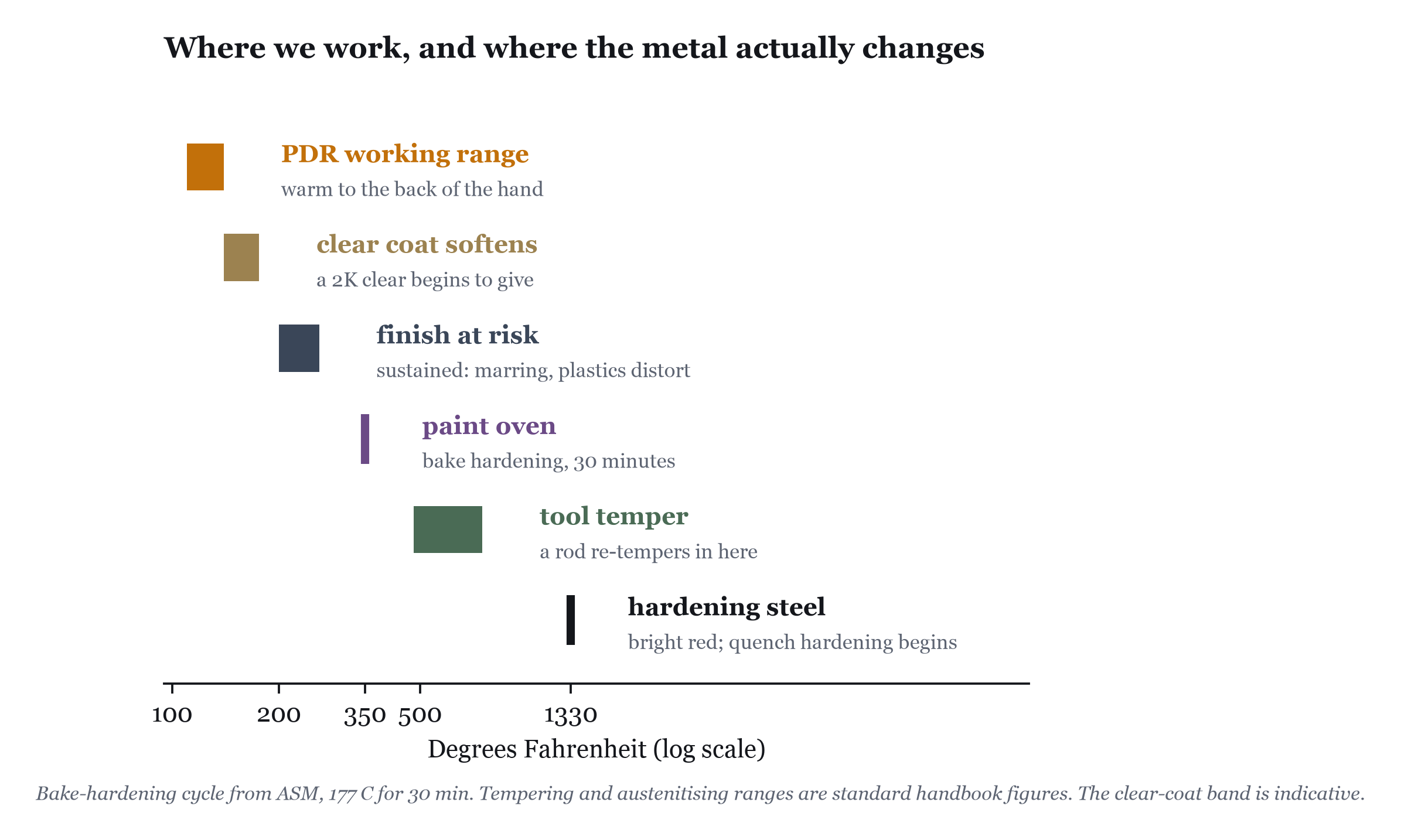
Which raises the obvious question. If the metal is unchanged, why does a warm panel work better? Because two other things on that panel are not unchanged, and both of them are polymers. The first is the paint. A modern clear coat is a cured film with a softening range, and unlike steel it is strongly temperature dependent in exactly the band we work in: our hundred and ten to a hundred and forty sits just below where a typical two-pack clear begins to soften. Warmed into that region the film becomes more compliant, which means it follows the metal instead of resisting it, and is less likely to crack when you move the panel underneath it. The second is the adhesive, and it gets a section of its own below. Set against those two, the metal is a bystander.
I want to be plain about the standing of that claim, because this book has a rule about it. The thermal numbers are handbook values and the cooling figures are my own calculation from them, with the assumptions printed in the note. The conclusion drawn from them, that heat in paintless dent repair is a coatings and adhesives tool rather than a metallurgical one, is my inference. I have not found it stated anywhere in either literature. I believe it because the alternative requires the metal to change at temperatures where it measurably does not, and because it explains the two things every technician has already noticed: that the passed flame does nothing, and that sustained gentle warmth does.
Heat in this trade is not a metallurgical tool. It is a coatings and adhesives tool. The metal is a bystander.
12.4Working with heat, properly
All of which produces a method rather than a ritual.
- A heat gun, not a flamecontinuous and controllable
- The requirement is a steady temperature held over an area for as long as you are working, which is precisely what a flame cannot do and a gun can. The goal is a warm panel, not a hot spot.
- A non-contact thermometerread the panel, not the gun
- An infrared thermometer costs very little and settles every argument in this chapter. Without one you are not controlling temperature, you are guessing at it, and the whole method depends on knowing the number.
- A hundred and ten to a hundred and twentythe working band
- Warm to the back of the hand, not hot. A hundred and forty is the ceiling on most panels, and every panel is different. Going higher buys you nothing in the metal and starts costing you in the finish.
- Anything plastic, and anything touching itthe real limit
- Paint on a flexible substrate, a bumper cover, a mirror base, a lamp housing. The coating on plastic will be ruined long before the metal notices the heat, and metal conducts into whatever it is bolted to. The limit on a mixed assembly is set by its most fragile part, never by the panel.
- Never walk awaynot for anything
- A heat gun left playing on a panel is an unattended fire in slow motion. There is no repair worth the telephone call you step away to take.
12.5Letting it come down
Then the half that gets skipped. Warm metal is for pushing. Cooled metal is for tapping. Give the panel time to come back down on its own before you start knocking anything, because the same compliant film that let the paint follow your push will also take a mark more easily under a localised impact. Build that pause into the job, and say so when you quote it: a customer who has been told the panel has to rest understands a technician standing still. A customer who has not been told thinks he is watching a man do nothing.
And do not chase the cooling. Never shock a warm panel with ice or with cold spray. The instinct to avoid it is exactly right, though the usual explanation for it is not: you cannot harden a body panel by quenching it from a hundred and twenty degrees, because hardening steel that way requires temperatures ten times higher. What actually happens is worse than a myth and more ordinary. The surface contracts hard while the metal underneath is still warm, which locks a stress into the panel you have just spent an hour taking stress out of, and which puts the clear coat into sudden tension at exactly the moment it is least able to take it. The advice is sound. The reason is thermal, not metallurgical. Let it cool the way it warmed: slowly, evenly, and without being interfered with.
12.6Heating the tool
The other half of heat in this trade is heat applied to the instrument rather than the panel. It is done for one purpose above all: to get a whale tail or a flat bar through the adhesive that sits between an outer skin and the bracing behind it, so that the tool can reach a dent that is otherwise walled off. It works, it is legitimate, and it comes with a cost this trade almost never names.
That cost is temper. Chapter one set out what a rod is: spring steel, hardened and then tempered, and the tempering is what gives it the particular stiffness you have learned to feel. Tempering happens at between about four hundred and eighty and seven hundred and fifty degrees Fahrenheit, which is well below visible red. So a rod you have heated until it coloured is not the rod you bought. It has been re-tempered by you, in a car park, to a temperature you did not measure, and it is now softer and more willing to take a permanent set. Chapter one, naming the tool metals, said that a rod with a memory of its own is a rod that lies to you. This is how you give one a memory. Heat the working end briefly, keep it well short of any colour change, and accept that a bar you use this way regularly is a consumable rather than an heirloom.
There is a second cost, and chapter two stated the rule it breaks when it dealt with the electronics behind the panel. A hot tool laid against the inside of a panel is a hot spot on a surface whose far side you cannot see. Everything behind that panel that heat can reach is now in the path: the loom, the module housing, the barrier, the sensor body. Know what is on the other side before you put a heated tool against it.
12.7The glue behind the panel
Which brings us to the material most responsible for heat being in this book at all. There is adhesive behind almost every outer panel on a modern car, it is not all the same adhesive, and the difference decides whether heat is your tool or a waste of ten minutes.
- Anti-flutter masticresponds to heat
- A soft bead between the outer skin and the inner panel or brace, there to stop the skin drumming. This is the one you can work with. It softens when warmed, which is why the hot whale tail works, and it is the bond most often standing between your tip and a dent.
- Hem flange adhesivedoes not respond to heat
- Runs inside the folded edge of a door, hood or tailgate, and is a one-part epoxy cured in the same paint oven that bake hardened the panel. A thermoset does not re-melt: heat it far enough and it chars rather than releases. Anything that cured at three hundred and fifty degrees will not be persuaded by a heat gun you dare point at paint.
- Structural and crash-durable adhesivedoes not respond to heat
- Bonded joints carrying load, increasingly in place of welds, and heavily used on bonded aluminium bodies. This is the Audi answer. It is not that the glue is unusually stubborn: it is that it is a cured thermoset doing a structural job, and it was never going to soften. Cut it, go around it, or accept the panel is closed.
- Expandable structural foamdoes not respond usefully
- Sits in cavities and pillars, expanded and cured in the oven. You will meet it as an access problem rather than an adhesive problem.
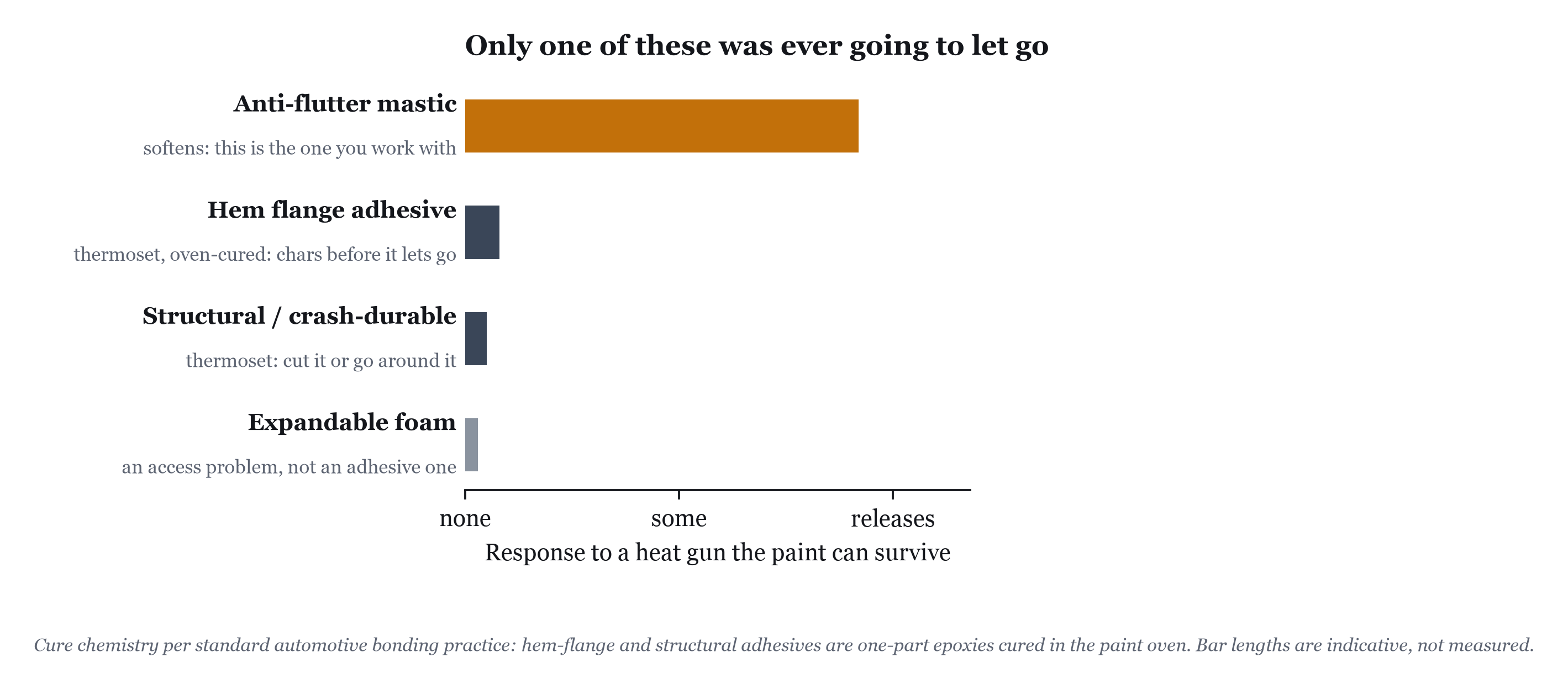
So the working question is never will heat open this? It is which bond am I actually up against? If it softens at a temperature the paint can survive, it is mastic, and heat is the right tool. If it does not, it is a cured thermoset, and no amount of patience changes that: you will damage the finish long before the adhesive yields. Cut it, reach it another way, or tell the customer the panel is closed. A technician who keeps heating a thermoset is not being persistent. He is being uninformed at the customer's expense.
12.7.1When the glue is holding the dent
Now the observation that makes this whole chapter worth its pages, and I have never seen it written down anywhere. Consider what happens when a panel is pushed in over a bead of anti-flutter mastic on a hot day. The skin deforms. The mastic, warm and compliant, deforms with it, and then the car cools and the adhesive sets in the new position. The bond is now holding the dent. The metal is not locked by tension or by a crown or by anything in the panel at all. It is glued where it is.
That diagnosis has a signature you can learn. The dent sits over a brace or a bonded line. It does not respond in proportion to the force you put into it: a little push produces almost nothing, and a larger push produces almost nothing, which is not how metal behaves when metal is the thing resisting you. And it will not read as a normal crown under the light, because there is no tension ring to release.
When you see that, stop pushing and go after the bond. Warm it, release it, and let the skin come off the brace, and a surprising number of these panels simply return once they are allowed to. Then reset it. Sometimes the repair is not moving the metal. It is letting go of the metal you were fighting for, and the bond is one of the few things in this trade that can hold a dent without ever appearing in the light.
Sometimes the metal was never locked. It was glued where it was.
So heat, honestly stated. The torch does nothing because a thin panel sheds two thirds of what you give it inside two minutes, and because a flame heats a point rather than a panel. Aluminium is not stubborn, it is conductive, and the answer is area rather than intensity. At the temperatures we work at the metal is essentially unchanged, so what heat buys you is a compliant paint film and a mastic that will let go, which is why sustained gentle warmth works and a passed flame never did. Read the number with a thermometer, respect the plastic before the steel, never walk away, push warm and tap cool, and let it come down on its own. Heat the tool if you must, knowing you are spending its temper to do it. And before you decide a panel is refusing you, find out whether you are arguing with the metal at all, or merely with the glue behind it.
Notes
- Cooling is estimated as a lumped body: the time constant is ρ·c·t / 2h, where ρ is density, c specific heat, t sheet thickness and h the combined convective and radiative coefficient per face. Taking 0.75 mm steel (ρ = 7850 kg/m³, c = 460 J/kg·K) and h ≈ 12 W/m²·K per face in still air gives τ ≈ 113 s; 1.0 mm aluminium (2700 kg/m³, 900 J/kg·K) gives τ ≈ 101 s. Moving air, a breeze or an outdoor job shortens both considerably. Thermal property values are standard handbook figures; the calculation and its application to a repair are the author's. ↩
- Thermal diffusivity α = k/ρc. Steel: k ≈ 50 W/m·K, α ≈ 1.4 × 10⁻⁵ m²/s. Aluminium: k ≈ 237 W/m·K, α ≈ 9.8 × 10⁻⁵ m²/s, a ratio of about 7. The distance heat spreads in time t goes as √(αt), so the spread ratio is about 2.6: roughly 12 mm against 31 mm in ten seconds. ↩
- “Bake hardening is the increase in strength of prestrained steel resulting from a combination of work hardening during part forming and strain aging during the subsequent paint/bake cycle (177 °C, or 350 °F, for 30 min).” “Attributes of Advanced High-Strength Steels,” in Advanced High-Strength Steels: Science, Technology, and Applications (Materials Park, OH: ASM International, 2013). See chapter one on the bake hardening of the panel steels. ↩