
Chapter Four
A Language for the Craft
Every mature trade eventually develops a vocabulary precise enough to carry difficult thought. Surgeons do not point vaguely at that thing near the bone. Pilots do not describe instruments as the little gauge on the left. Precision in language is not pretension. It is efficiency. Paintless dent repair has spent a surprising amount of its life without such a language, and the cost of that absence is the subject of this chapter. What follows is a working vocabulary for damage: what a dent actually is, how damage should be classified, how the story of an impact can be read backwards out of the panel, and what the two great families of damage demand of a technician who intends to repair them deliberately rather than hopefully.
4.1One dent, ten names
Ask ten technicians to describe a circular dent and you may receive ten terms. One company has a classification. Another technician calls it an egg. Someone else calls it a corona. A third invents a word on the spot and teaches it to everyone in his shop. None of this prevents repairs from being made. It does make teaching unnecessarily difficult, and the problem turns serious the moment we move beyond simple damage. If I tell you to work the crown, what do I mean? Which crown? How much? In what order? If I tell you to open the dent, what exactly are you opening? If I say the panel is locked, what relationship inside the damage created the lock? When the vocabulary is vague, the thinking goes vague with it. The purpose of terminology in this book is therefore practical. I am not trying to make dent repair sound scholarly. I am trying to give us handles strong enough to carry complicated ideas.
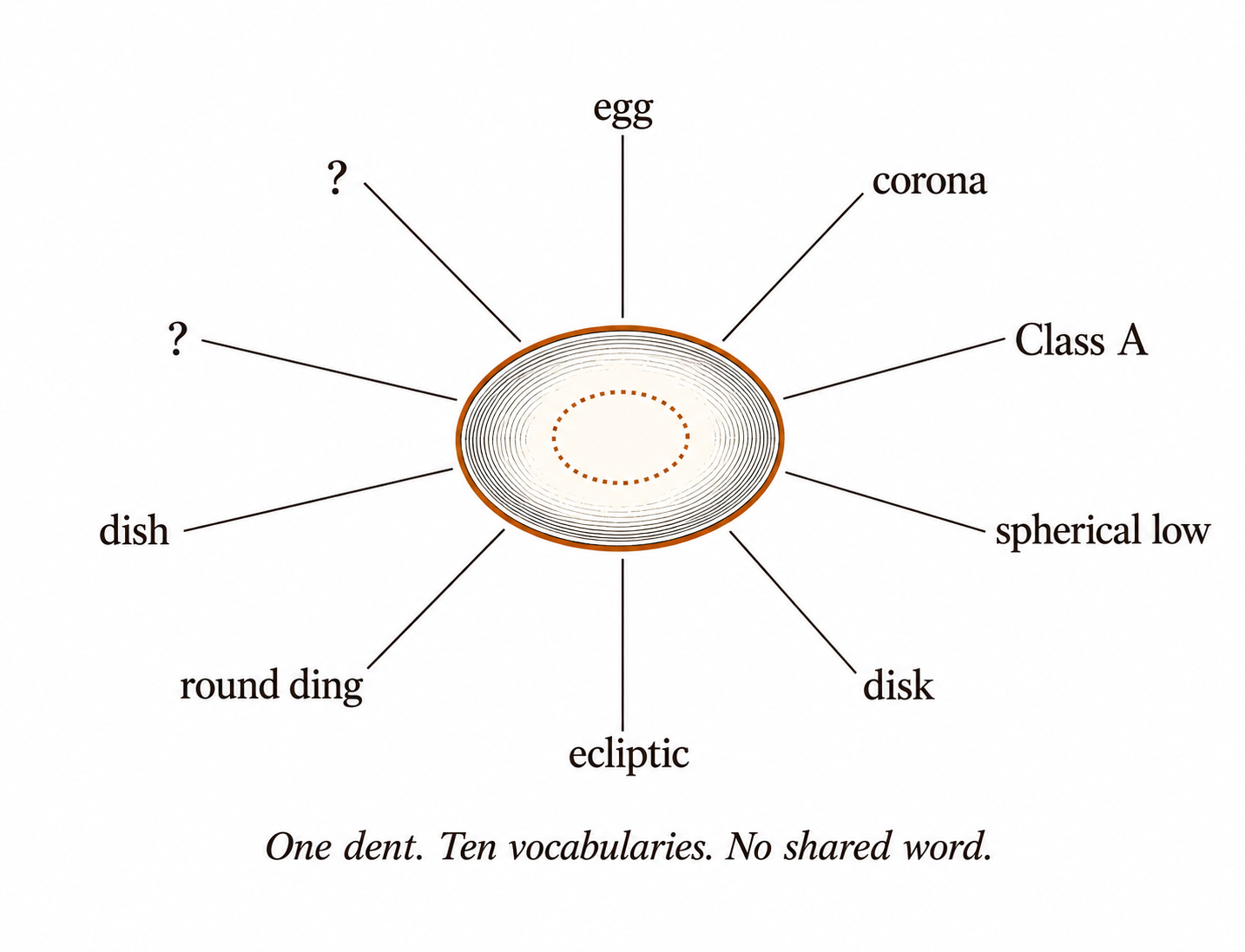
When the vocabulary is vague, the thinking goes vague with it.
4.2Dentology, and the terms it needs
I use the word dentology for the systematic study of minor panel damage and its correction through paintless methods. A dent, in this framework, is any discontinuity in a panel's resistance, stiffness, or shape from its original factory condition. That definition is deliberately broad. It does not care whether the damage is the size of a dime or a dinner plate. It does not care whether hail, a shopping cart, a fist, a door, or another vehicle caused it. It says only this: the panel once possessed a particular state, and now possesses another. From that we get the first important distinction, between the original condition and the damaged condition. From there we can classify how the damage was introduced. Some dents come from a dynamic strike, such as hail or an object hitting the panel. Others come from slower structural resistance, such as an outer skin driven into a brace. Engineers draw the same line and have measured it: they distinguish dynamic denting, where the load arrives fast, from static denting, where it arrives slowly, and they test the two separately because panels do not answer them the same way.1 Hail and a leaning shopping cart are not one event at two sizes. They are two mechanisms. It is worth marking the boundary of the method in the same breath, because a craft is defined as much by what it refuses as by what it does. Paintless dent repair does not cut or weld. It does not fill. It does not use high heat to shrink. It does not restore panels that have been severely stretched or crushed. Those methods distort metal or damage the paint film, and heat in particular causes uneven expansion and contraction that leaves you with more deformation than you started with. Where the paint has fractured or the metal has genuinely stretched, this method may still improve the damage a great deal, but a perfect restoration will want conventional bodywork, and you should say so out loud. Knowing where the edges of the craft lie is not a limitation on it. It is most of what makes the estimate honest.
You will also hear me distinguish microdynamic damage from macrodynamic damage. Do not make the mistake of assuming that micro means small and macro means large. The dividing line is complexity. A tiny dent on a sharp body line, over a brace, on aluminium, with compromised paint, can be a macro problem. A large shallow dent in open steel may behave far more simply. This is why pricing by diameter alone is so dangerous. When I look at a dent I score several factors in my head: breadth, length, depth, location, alloy, paint condition, structural obstruction, environment. The point is not to produce a magical total. These factors do not cancel one another. A perfect access score does not rescue paint that is already failing. A shallow dent does not become easy because it is shallow, if it sits on a sharp edge with no usable leverage. What I want you to notice is where the difficulty is concentrated.
Each factor tells you something specific. Breadth tells you how much panel is involved. Length matters especially in creases, because you are repairing a path rather than a point. Depth tells you about stretching, and how far the metal has moved beyond its easy elastic behaviour. Location changes stiffness and access. Alloy changes spring response and work behaviour. Paint determines how much movement the finish will tolerate. Obstructions determine how you can reach the work. Environment affects visibility, temperature, and control. A young technician prices the dent he can see. An experienced technician prices the problem he expects to meet. That difference is worth a great deal of money.
4.3Mapping the origin
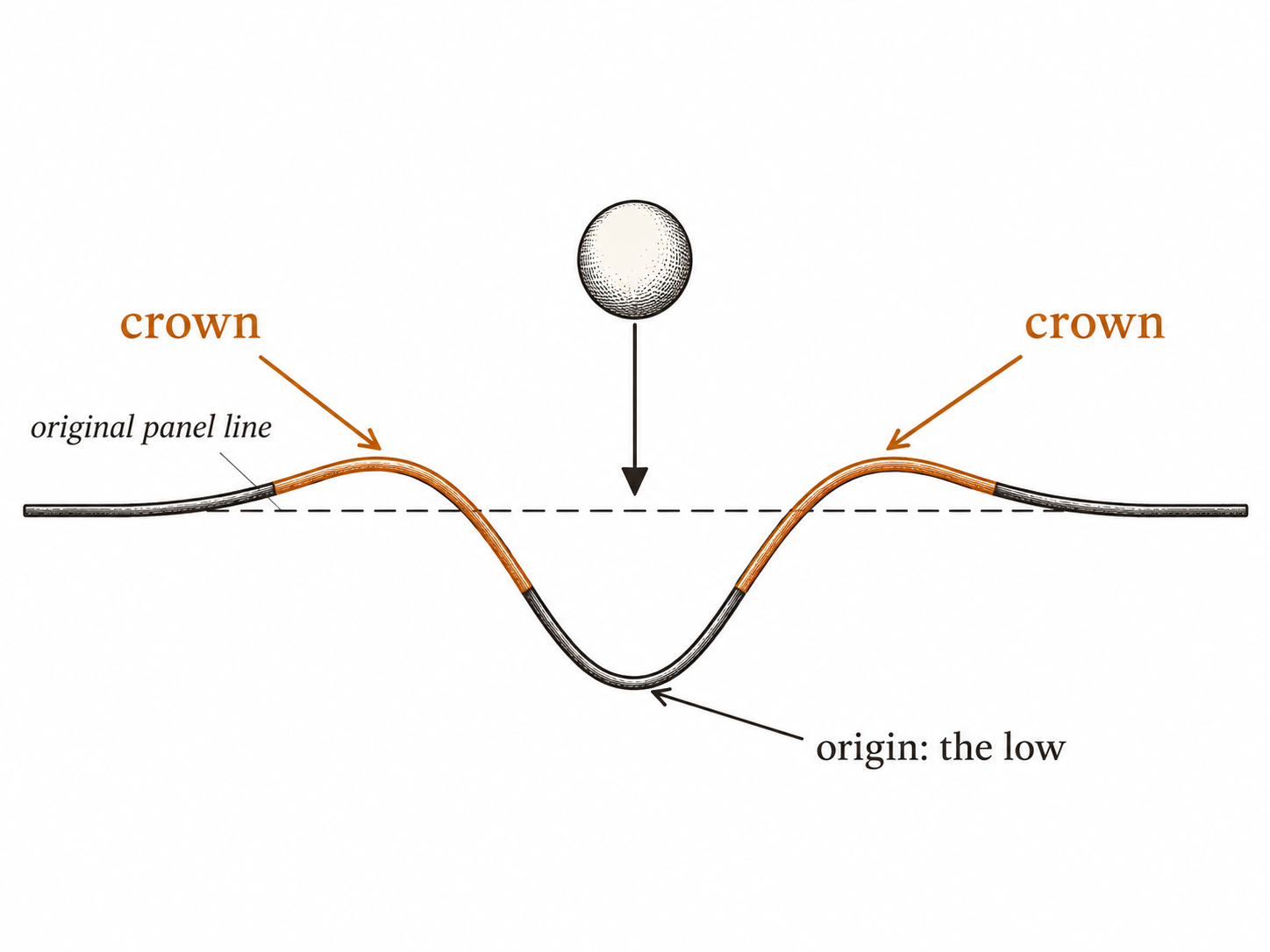
Before you touch a panel, learn to map the origin. The origin is the central or deepest region created by the impact, and in a simple circular dent it may be obvious. In a large dent there may be several origins, overlapping paths, crowns, secondary impacts, and structural influences. Your task is to reverse engineer the story. What struck the panel? From which direction? Where did the force first concentrate? Where did the metal travel? Where did it pile up? Which part of the damage is primary, and which parts are consequences? This is not unlike examining tracks after something has crossed a field: you read what remains in order to infer what happened. My military background gave me a comparison that has always made sense to me. With incoming rounds, splash analysis tells you a great deal about direction and angle, because the mark is not merely damage. It is information. A dent is the same. Its shape contains a history, and the technician who reads that history begins with a plan while the technician who ignores it begins with a guess. Part of that history is written in the strain paths: the routes along which the energy actually travelled through the panel. They are invisible, but they announce themselves in the way light bends around the damage, and they settle four things worth knowing before you touch anything. Where the metal is tight. Where it is soft. How far the dent really extends. Which regions must be corrected first. Force travels the path of least resistance and takes its direction from the geometry of the panel, which is why a dent with long strain paths can look small and behave large.3 Learning to see them is one of the largest single advantages available in diagnosis.
4.4The circular dent
One of the first forms you should learn to read is the circular dent. We call it circular because that is how it appears in ordinary conversation. Geometrically it is closer to a shallow portion of a sphere. Imagine dropping a golf ball onto a hood. The centre moves inward, the metal around it responds, and a raised region forms around portions of the impact. We call that crown, and crown is displacement made visible. The object did not simply create a low point. It moved a system. Few habits will serve you better: stop seeing the dent as only the low. The low is part of the event, but the crown, the tension, the edge, the brace, and the surrounding curvature are also part of the event. This is why pushing the deepest point harder does not always improve the dent. Sometimes the metal cannot rise because you have not released what is holding it.
Crown is displacement made visible. The object did not simply create a low point. It moved a system.

Circular dents can be approached through several useful patterns, and chapter six is the catalogue of them: spirals whose spacing is matched to where the depth actually sits, islands, rasters, and the one pattern to refuse. The principle behind all of them belongs here, with the vocabulary. Match the density of your work to the density of the problem. Do not worship the pattern. Use it. What matters is that you know why you chose the method, because randomness is not a method merely because it eventually works. Many technicians repair circular dents by what I call the chew method: push somewhere low, tap somewhere high, push again, tap again, and continue until the panel looks flat. This can absolutely produce a good result. The danger is that the technician never learns which actions were necessary and which were merely repairs to his own previous actions. Efficiency begins when you can separate the two.
4.5Creases
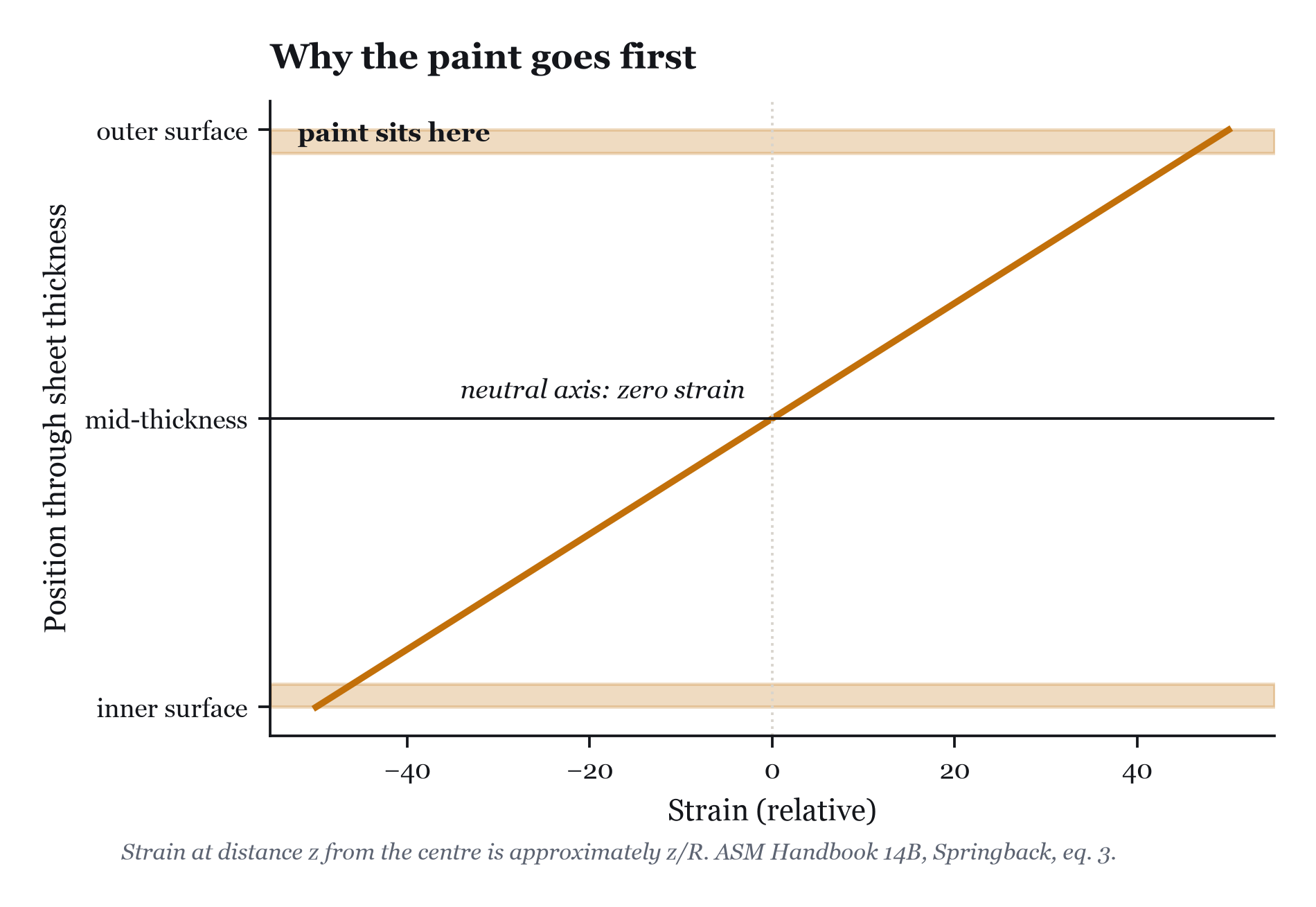
Creases require a different way of seeing. A crease is usually created by movement across a relatively stationary object, and it has a path. I call the lower path the trench and the surrounding sides the embankments, or banks. A crease has both a lengthwise origin and a crosswise relationship between the trench and its banks. Three working rules matter immediately. Do not fold the embankment over the origin. Open the embankment rather than closing it. Make your passes along the path of the crease. You must also determine entry and exit, because a crease can be locked at either end, and if you tighten the wrong region too early you may create a problem that did not exist before you began. When people ask how deep a crease can be repaired, I usually tell them they are asking the wrong question. Depth matters, but paint often decides the job before depth does. Visible paint loss is simple. You can see it, the customer can see it, and if the metal becomes beautiful the paint will still be missing, so explain that before touching the car. Hidden paint damage is more dangerous. A finish may appear intact while being folded so severely that releasing the metal exposes a crack that was effectively created at impact. The technician is blamed because the crack became visible during the repair, but the real problem existed before the first push. There is a reason the finish is the first thing to go, and it is geometric rather than chemical. When a sheet bends, the strain is not shared evenly through its thickness. It is proportional to the distance from the centre of the sheet, which means it falls to nothing in the middle and reaches its maximum at the two surfaces.2 The paint sits exactly where the metal is worked hardest. That is why a sharp crease can split a finish that a deeper, gentler dent leaves untouched, and why the damage can be done at the moment of impact and merely uncovered later by you. Learn to identify that risk and communicate it. Remember that a crease must be worked in passes: find the centre, respect both sides, and do not attempt to win the whole battle in one push.
4.6Wake dents, elevated metal, and the rest
Other forms of damage deserve names as well. Wake dents are broad, easily missed distortions that can wave across a panel. Elevated metal is what many technicians casually call a high spot. Lateral hyperextension occurs when a tool rotates or flips inside a panel and creates unintended movement. Spacial parrying describes a sharp low that causes the tool to slide away from the very point you are trying to attack. Then there is damage created by another technician, which is some of the most deceptive work you will ever price. When someone else has already worked the panel you are no longer reading the original event. You are reading the original event plus another man's decisions. A poor repair may have moved crown, created highs, locked edges, stretched regions, and erased clues that would have told you how the damage began. Imagine being asked to paint a battleship on a blank canvas. Difficult, perhaps, but at least the canvas tells the truth. Imagine being handed someone else's half finished battleship and told to make it yours. Before you can paint correctly, you must discover what should not be there. Work of that kind is negative displacement.
4.7Two words for two actions
Finally we need two words for the two actions we perform all day. I use amelioration for moving metal upward and pejoration for moving metal downward. You may continue to say push and tap down at the panel. The formal terms simply allow complicated written descriptions to stay precise. That is the test every word in this chapter has to pass. A dent is a discontinuity from a known original state, so the same definition covers hail and a shopping cart. Complexity rather than size separates micro from macro: a coin-sized dent can be the harder job. The origin carries the history of the impact, and reading therefore precedes pushing. Crown is the system responding, and the low is never the whole story. The circular dent wants a pattern matched to its depth. The crease wants passes along its path. The paint, not the depth, usually decides whether either can be done at all. If terminology helps us think more clearly, keep it. If a word merely makes us sound clever, throw it away. The panel does not care what we call anything. But the apprentice does.
Notes
- Static and dynamic denting are treated as separate mechanisms, distinguished by the rate at which the load is applied, and are tested by different methods. D. Thomas, B. Hodgins, M. Worswick, M. J. Finn and K. Gong, “Static and Dynamic Denting of Paint Baked AA6111 Panels,” SAE Transactions 110 (2001): 993–1006. ↩
- For a sheet bent to radius R, the strain at a distance z from the centre is approximately z/R: zero at the mid-thickness, greatest at the surfaces. R. H. Wagoner, J. F. Wang and M. Li, “Springback,” in ASM Handbook, vol. 14B, Metalworking: Sheet Forming (ASM International, 2006), 733–755, eq. 3. See also “Bending of Sheet Metal” in the same volume. ↩
- Force follows the path of least resistance through the geometry of the panel; the resulting strain paths govern where metal is in tension and where it is slack. This is treated at length in the classical panel-beating literature: F. Sargent, The Key to Metal Bumping (Los Angeles: Auto Body Publishing), and A. Steines, Moving Metal: The Art of Chasing and Repoussé (Huntingdon, PA: Blue Moon Press, 2001). ↩